Although I am retired from full time self-employment, I remain the Village Wisewoman of St Buryan, Cornwall. I have set up this blog to share with others my thoughts, feelings and opinions of the ever changing face of my Craft.
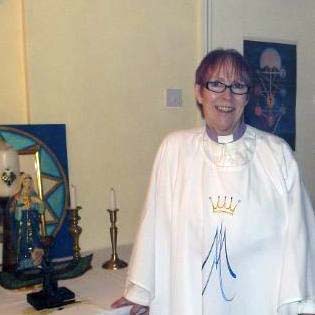
Pam Masterson 17th December 1947 – 16th October 2015
Photo credit: Emma James
On Friday 16th October 2015 I performed a simple Last Rites ritual and said farewell to a dear friend. Within two hours she passed away peacefully with her family by her side.
Most of you would have known Pam as the entertaining and knowledgeable owner of The Healing Star situated at the top of Causewayhead, Penzance. Pam successfully ran this shop for 14 years selling esoteric artefacts and paraphernalia, and also hired out the back room for various spiritual and healing functions. Indeed the Penwith Pagan Moot utilised this room for many years.
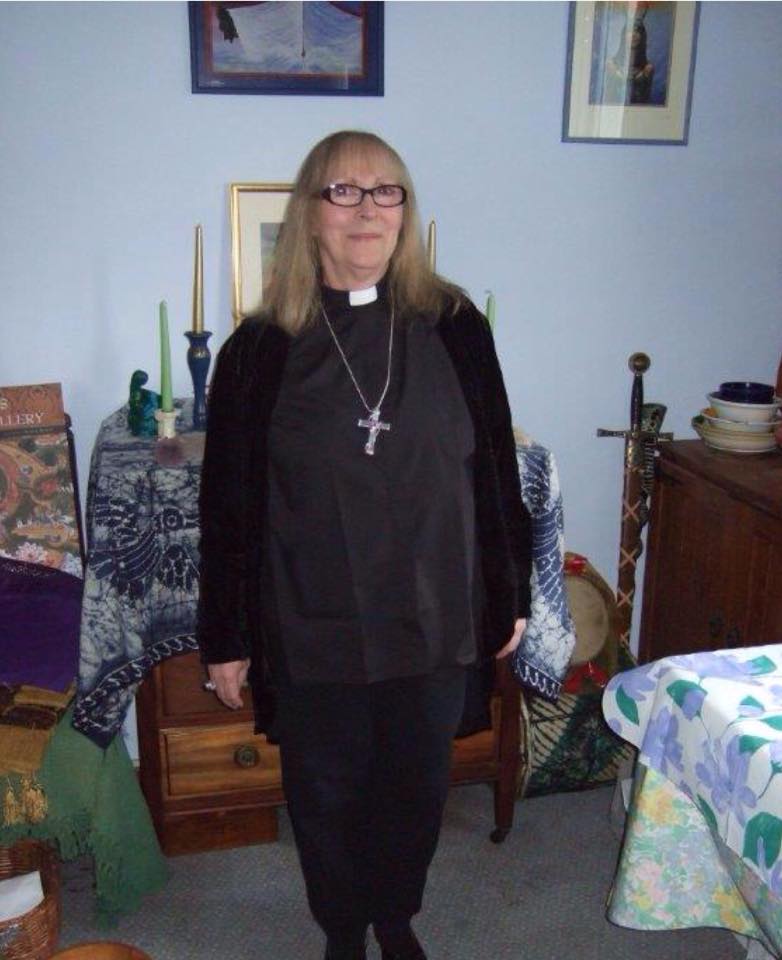
However, Pam wasn’t only a shop proprietor; she also studied and attained the level of Swami Bodhini, British Yoga Wheel Teacher of Yoga Nidra for over 35 yrs. She also held the title of The Very Reverend Pamela Masterson of The Stellar Maris Independent Church of The Mysteries. As you can imagine there were quite a few humorous stories associated with Pam being a Bishop well before the Church of England had got its act together about such issues!
Photo credit: Emma James
Over the years I knew Pam, I found her to be highly articulate about many subjects and she was an authority on the Kabala and the Egyptian mysteries. She did not suffer fools gladly and was completely up front with calling a spade a shovel on many occasions! I respected her viewpoint on many things and I loved her dry witticisms about the vagaries of life and people in general. Pam was always up for a good robust discussion and airing of viewpoints and ideas.
Over the last couple of years Pam battled bravely, with humour and fortitude (and a lot of stubbornness!), a long standing and debilitating medical condition that eventually she succumbed to.
I, along with many others, will miss her greatly and the local community of spiritual healers and practitioners is the poorer as a result of her departure.
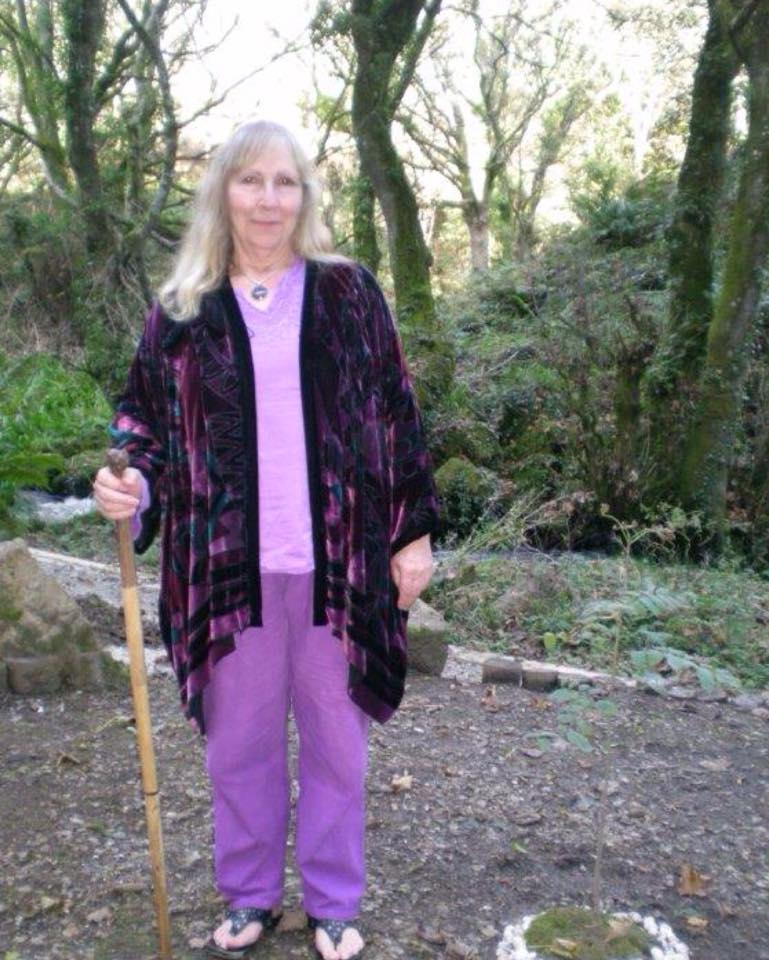
Rest in Peace Pam – you were a true Priestess.
Photo credit: Emma James
Funeral will be held on Tuesday 27th October 2015, 3.00pm at Camborne Crematorium.
It’s hard to believe that there hasn’t been a Museum of Folklore before in Britain. I just imagined that there would be one somewhere tucked into a little side street off Kensington. I remember vividly being taken to most of the main museums in this area when I was a child. I used to gaze in awe and wonder at extraordinary things in the Natural History Museum, Science Museum, British Museum and so on and so forth. Even in later years when I was employed in London as a teenager, I used to spend most of my lunch hours trailing round the more little known establishments and curiosities near where I worked. I have a fascination for such places…
Now there are plans afoot for the first Museum of British Folklore and rather than write reams here on this blog, it’s probably better – and more concise to guide you towards this promotional video:
Exciting stuff! One of the ongoing projects that caught my attention in the early days of meeting Simon Costin, Director of the Museum of British Folklore, was the ambitious Morris Doll collection. The aim is as follows:
The museum has launched a new initiative to represent the wide variety of Morris sides within the UK. Any teams wishing to take part will be sent a blank figure to decorate with their team kit. The idea being that over time, the collection will grow into an original and unique visual record created by the people who participate in the dance. For any teams wishing to receive a figure, please email us – mofbf@clara.co.uk
Story posted on September 21, 2013 from the Museum of British Folklore’s website:
I have belonged to a Morris side for about five years now, so had a special interest in creating a doll that would be part of a display in a museum. The side I’m with is called Boekka (Cornish for Scarecrow) and I’m a founder member. Myself and Laetitia along with her son Rhys first formed this group following the departure of our Obby Oss, who used to be a Penglaz, from the Golowan Festival. We changed her appearance, her name and title – she then transformed into Penkevyll the Lands End Obby Oss appearing alongside Boekka.
Following many months of pestering the beleagured Simon (a notoriously busy man!) eventually a large package arrived at our cottage containing not one, but two dolls. This lead us to believe that maybe they wanted us to create not just a doll representing our side’s Morris dancer, but also our famous (or should that be infamous?) Obby Oss as well! Simon had seen our Oss, Penkevyll in 2012 at Charms Day in Boscastle when Boekka gave a performance to wind the day’s events up.
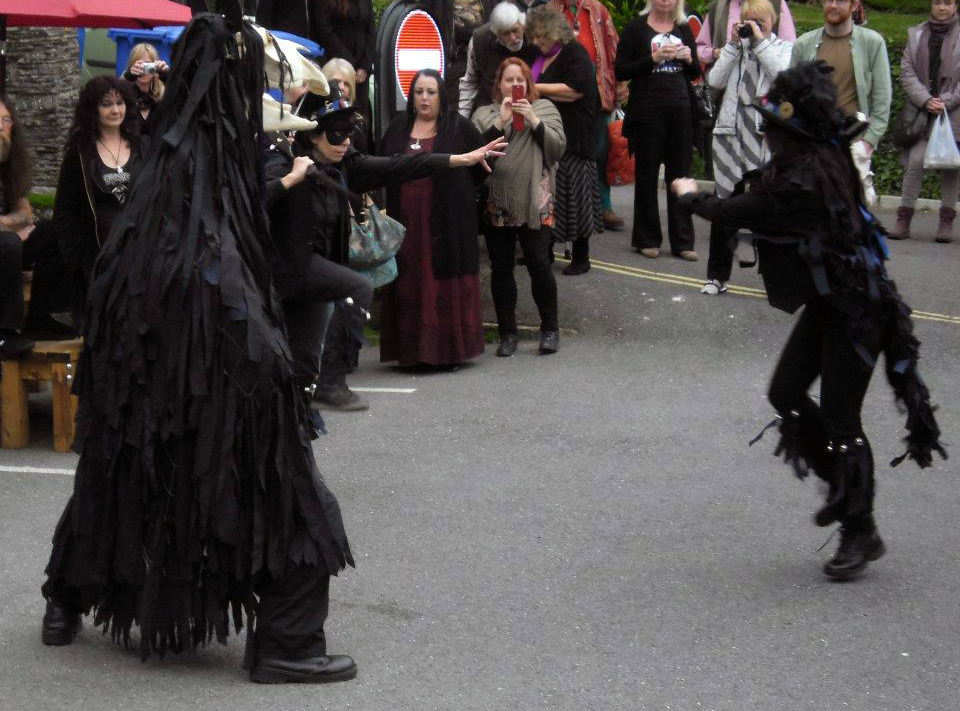
Boekka & Penkevyll Charms Day Boscastle 2012
Boekka & Penkevyll Charms Day Boscastle 2012Boekka & Penkevyll Charms Day Boscastle 2012
So it was time to start making the dolls. First job was to assign who was going to do what – always a tricky one! We started on the Teazer doll first. Laetitia drew the short straw and was lumbered with all of the sewing. She has small hands and produced neat work creating the T shirt, tailcoat tatters, trousers and boots. (This is what comes from being really good at something, you become the victim of your own success – a lesson I have found out many times to my cost!) Whereas, I have large hands for my size and am very clumsy with tiny, meticulous work. I sourced materials, created and cut out templates and was a general ‘gofer’ (go for this, go for that etc).
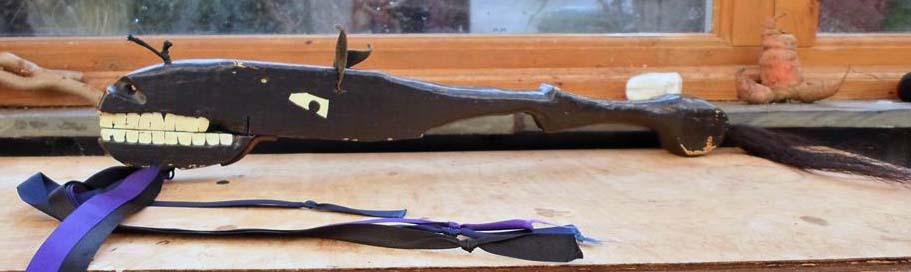
We were trying to think of how to make a snapper for the doll. This is what we were trying to replicate:
Teazer Snapper
I asked a good friend of mine, Chris White for advice on how to make this as he is into model making; and before I knew it he had kindly offered to help us out by creating it himself – and what he created was superb!
Chris is an amazing guy who we have meet only via the Internet/Facebook. He used to be a Beast Rider with a Morris side and has a really fine sense of what is required of someone who dares ride these fabulous creatures. Sadly he no longer is able to do this as he has a progressive medical condition that has rendered him seriously disabled. However, he has an indomitable, cheerful spirit and a delightful sense of the absurd and ridiculous. He often has Laetitia and me crying with laughter over something he’s written – he’s particularly good at finding the right caption for many photos, especially ones that include Obby Osses and the like. One day we would love to meet him. 🙂
After several weeks of sporadic work on our Teazer doll in between work and gigs, we finally had our completed doll:
Then it was time to consider the Oss doll. We had approached a local lady who makes, amongst many other things, marionettes and puppets. We knew she would do a very good job but we weren’t too sure whether we could afford her services, even though we were offered ‘mates’ rates’. As Chris had already alluded to the possibility before, I tentatively approached him and asked whether he was interested in attempting the unusual modelling project of making a mini sized Penkevyll head for our doll, although we insisted on paying him for materials. Chris said he would be honoured and to offer him money for the privilege would be tantamount to offending him – so we quickly agreed! 😉
Between me and Laetitia we created another T shirt, trousers and boots, plus the Riders skirt for the doll and then waited for the necessarily long process of creating Little Penk’s model skull. It was such a fascinating process, and so many folks have asked us, that I think it best if Chris himself takes over the story at this point:
The Construction of Little Penk Chris White
I’ve been asked to write about how I did the construction of what all involved came to call ‘Little Penk’.
I’d just like to stress a couple of things. I’m disabled and this took months rather than days. Secondly I’ve never done anything like this before. Although my background is in art and design I have no skill in symmetrical sculpture and had to work out just how to do this from scratch. What I came up with was a combination of hybrid techniques that would give me a guide to work to as it progressed.
Living halfway up the country I didn’t have direct access to Penkevyll so I bought a digital model of a horse’s skull. I was lucky that one was available! I brought this into Cinema 4D, a program I’ve used in the past for digital modelling. It was used for the dragons in the Harry Potter films so it’s a really versatile program. I scaled the skull to size using photographs of Penk’s skull next to her ‘Rider’ so the small one would be the appropriate size next to the Teazer doll. The important first stage was to build the basic skull from a series of cross sections taken from the digital model, printed out of the computer then cut from a material called ‘Plasticard’. I found out about this from a friend who does a lot of model railway modelling. I hadn’t a clue what materials I’d need so this was the first step of many like this. All the cross sections had to be kept in careful order obviously until I could put them together. I used three different kinds of adhesives until I found one that did what I wanted too!
So now we have a rather fragile basic construct that gives us and accurate 3D reference to work on to. That’s the hardest part over. Very scary and very slow, that bit.
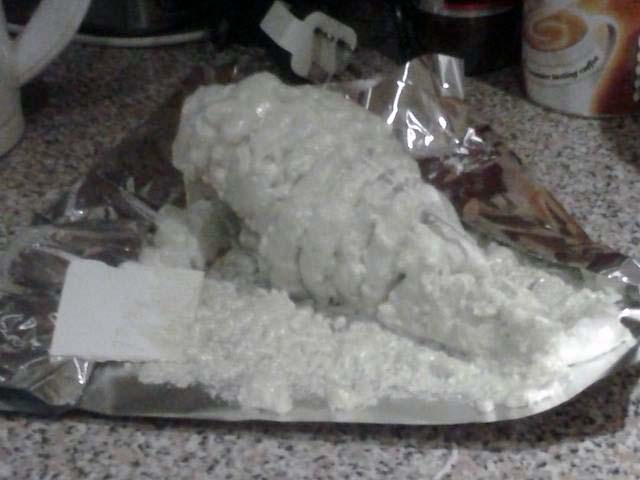
Next I used expanding insulation filling. This comes in an aerosol can and is a pig to use! It’s sticky and sloppy and risks distorting the flexible cross sections as it expands between them so I had to scrape some of this gloop out as it started to dry.
It expands so much it pretty much buries the form. However, weight is a major problem with man-animals of any scale and insulation foam gives you form with minimum weight. The adhesive property of the stuff bonds the Plasticard sections together very nicely.
Disgusting isn’t it? So now I could cut and sand the foam away back down to the surface of the cross sections without distorting the base of the shape. Now I had an accurate, symmetrical 3D shape.
Although I had a stable form it was still quite fragile so I had to coat it with something to give it strength. I opted for something like polyfiller. This was quite heavy at first but, being water based, it dried much lighter. I skinned this one and sanded it back as much as I could to retain the outline of the underlying form.
I’d been looking forward to this part. I love the delicate, architectural form of skulls, especially rodent and bird skulls.
The orbits of the eye sockets are particularly lovely and as the form refined I spent a lot of time just enjoying running my hands over the emerging shape. The more I did though, the more there seemed to be that needed doing! It’s just as well I didn’t have a deadline for this.
The fine point at the top of the nose was another piece of Plasticard which I embedded.
This brings me to the final ‘skin’. It had to be strong and light while being smooth, being able to take detail well and giving a good surface for paint. I found the perfect material. Called ‘Miliput’, it’s a two-part epoxy putty. Once I got it stretched onto the surface, working it carefully across the form, flattening and smoothing, I found that working with wet fingers makes it very smooth, taking out any finger marks and smoothing out irregularities in thickness beautifully! Once cured, it’s very hard; sands well and takes detail very well.
The teeth posed a bit of a problem. I opted for Plasticard again. To bend the teeth around the curve of the skull I heated the ‘denture’ in very hot water. Fortunately Plasticard is a thermoplastic so once heated and shaped, it will cool to that new shape and can be glued in position without it trying to flex back again.
To my delight the jaw fitted perfectly! All that slavish measuring and cutting at the beginning had paid off. Just as well, because to correct something like that in three dimensions would have been a nightmare. I drilled and hinged the jaw using a piece of coat hanger wire. All the usual bits and bobs that Animal keepers end up resorting to!
When it came to the eyes I decided to print directly from the photos of Penkevyll. Cassandra and Laetitia took such good pictures that I was able, correcting for distortion, to copy and scale the eyes straight from those. They were glued onto disks of Miliput and varnished to keep them bright and lively.
Since my fine art days I’ve always preferred alkyd paints. They have the depth and transparency of oils but dry much, much faster. They’ll go onto practically any surface and can be layered and glazed for depth and subtlety. Perfect for bone, then, as it’s such a tricky colour and changeable under different lights. Alkyd can take care of all that.
Finally the ears. I carefully copied the profile (thanks again to lots of rapid feedback from Cassandra!) for the ears and cut them from black leather.
Then came the support for the head. Tricky. Traditionally I’d always kept the internal bits of my Animal in my Green Oak days, strictly schtum. So it goes a bit against the grain. Nevertheless, this is essentially an archive piece so on we go. Although Penkevyll has a harness support, the doll would not be able to support this Animal so I had to think of an alternative. Pole mounted heads are traditional so I went with that option as it could be set to take the weight off the doll. I nobly sacrificed one of my metal walking poles. Let me tell you, aircraft aluminium is a pain to saw!!
Ears, jaw strung and working and staff mounted. Ready for the off! It’s been a long project but very enjoyable. I was able to test some ideas and see how much I’d retained of my skills. Truth to tell it was hard on the hands (as I’d suspected) and when I occasionally overdid it I had to take a few days off. But in the end I got a result that I was very happy with.
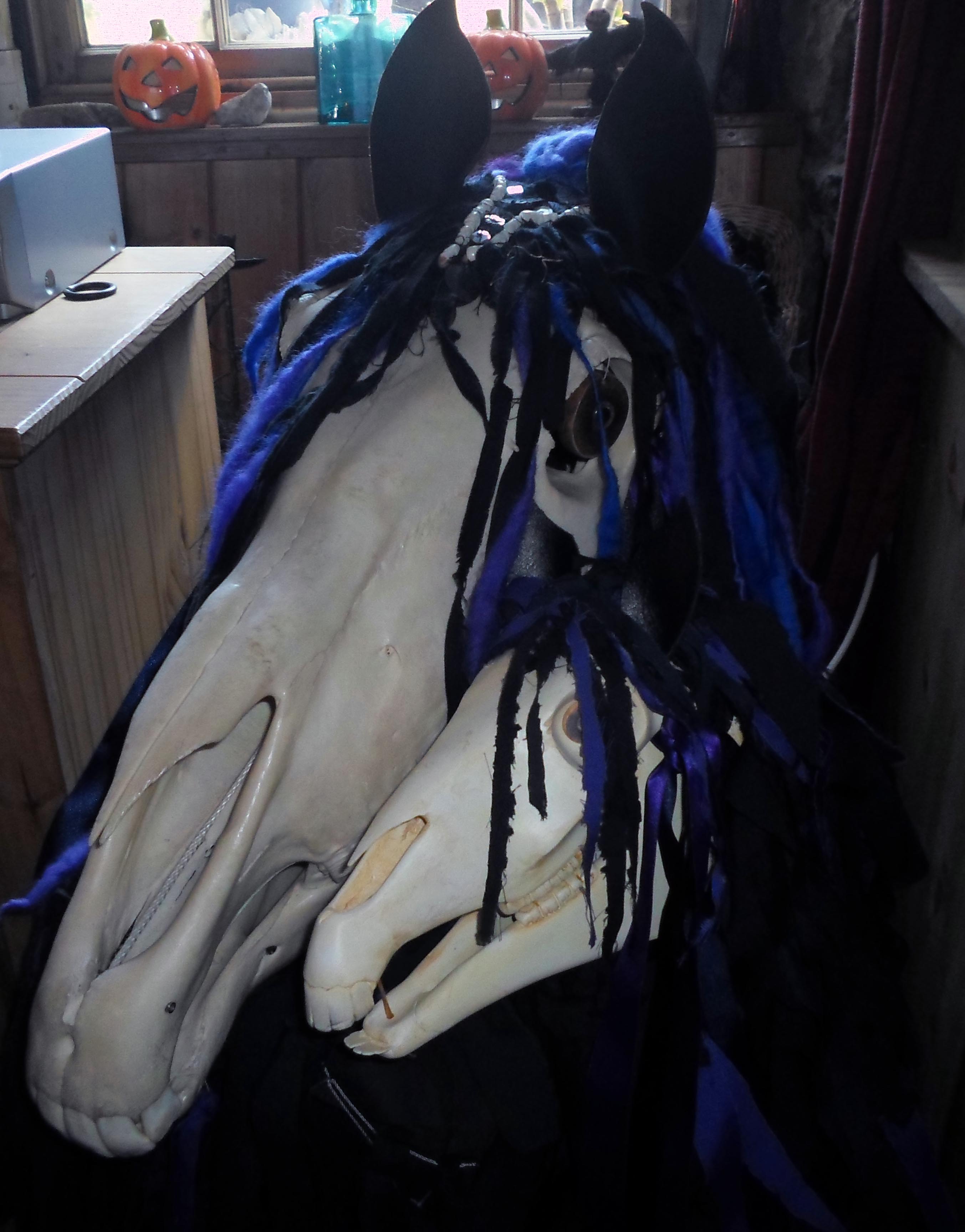
Next she was shipped to Cornwall to be properly dressed and coiffed by Latham-Jones Haute Couture. And a magnificent job they did too! See Cassandra’s pictures.
Photos in a moment. Once we’d got over oohing and ahhing over Chris’s remarkable work we set to finishing off the dolls. Together we managed to lash the doll to its accompanying pole, secured the ears and the mane that I had painstakingly woven loads of tatters into, and then Laetitia sewed on her gown which was lovingly covered in tatters.
Here’s a close-up of Little Penk’s head showing the skill of Chris’s work:
Then we introduced Little Penk to Penkevyll…
This is when we realised that Little Penk was looking far too neat, so I set to with a pair of scissors and made her tatters more ragged and more in keeping with the ethos of Boekka. Here are the final photos of all the dolls and Penkevyll together.
At last we were finished! Both me and Laetitia agreed that we didn’t want to trust the Post Office with delivering our finely crafted Oss & Teazer dolls – we had awful visions of them throwing the parcels across the room and ruining all that hard work. So I sent a deliberately tantalising email to Simon Costin and asked him when was he next down to the Museum of Witchcraft at Boscastle, as we had something very delicate and fragile with a guaranteed ‘Wow’ factor to deliver to him. It worked beautifully and we successfully delivered the dolls (which we had become quite attached to over the months) to the Museum. Here we are presenting Simon with them:
To directly quote Simon, ” Thank you so much for coming over with your wonderful creations! They really are spectacular.” It was well worth all the hard work and we look forward to seeing the dolls displayed within the next exhibition of the Museum of British Folklore. It’s good to know that you are producing something that will be preserved for prosperity and displayed within a museum environment.
Sadly this post will start off on a slightly negative note, but will hopefully soon rise above that and develop into something much more interesting.
About six months ago I was contacted by the Museum of Witchcraft managers and informed that the soundtrack to the Wisewoman’s Cottage tableau which I had narrated was being replaced by another that had been created by some of the Friends of the Museum. Although I was initially rather miffed that I hadn’t been consulted before this decision was made, I did agree that it had been a long time since the original recording and that it was time for new material.
Then just recently a link to Gemma Gary’s blog was circulated via the Museum’s Facebook page where it described the update of Joan’s Cottage by herself and others. Upon reading it I decided to rise above the rather disparaging comments made about the previous soundtrack, as everyone is entitled to their personal opinions, although I’ve never understood why some feel the need to denigrate what preceded them; however I couldn’t ignore what was an inaccuracy within the text. I politely pointed out to the Museum that despite what was stated, I did not get paid for narrating but gave my time and energy freely, and asked for the mistake to be rectified. The Museum duly got back to me and said that they would contact Gemma Gary and wrote an explanatory note on their blog page (where Gemma’s link had also been posted).
Please note: If you follow the link to the article, you will see that it suggests that the person who provided the previous incarnation of Joan’s voice (Cassandra Latham Jones) was paid. In fact, she gave her time voluntarily. We remain grateful to everyone who has been involved in any project which has been of benefit to the Museum.
All well and good I thought, sorted without any complications. Wrong! 😦
Far from discreetly amending her text, Gemma Gary in her wisdom chose to ‘up the ante’ and escalate the whole situation by writing the following:
“For many years now, visitors to the Museum have been able to hear the voice paid to represent ‘Old Joan’ [18/8/15 it has been brought to my attention that the provider of this voice claims to have volunteered her time. She was in fact paid to do ‘promotional work’ for the Museum. It was my understanding that the recording was part of this work] reciting (with the incongruous inclusion of the odd cold and sinister cackle) an extraordinary and wonderful collection of verbal charms and spells,”
This, a blatantly untrue statement, is ludicrous when one considers that Gemma Gary was not present, or ever involved in any of these events which happened nearly 20 years ago. No-one knows better than I, whether I was paid or not! Furthermore, I have never been paid for any promotional work for the Museum. Someone needs to check the veracity of their so called ‘facts’. As a direct result of this, Gemma Gary’s blog links were removed by the Museum from both the Facebook group and the Museum’s blog. It remains to be seen whether that lie stays within her blog – but whilst it remains I think it says more about Gemma Gary than it does about me.
Anyway, enough of all this unpleasantness and on to more interesting things. Although these events had unsettled me it did make me think about whether it might be a good idea to share exactly what did happen all that time ago as it’s quite an interesting tale. Certainly it would add a bit more clarity, and might even avoid future inaccuracies and assumptions from certain quarters.
Let’s go back to the late nineties, to 1997 to be exact. I had a phone call from Graham King who had recently purchased the Museum of Witchcraft from Cecil Williamson in Boscastle. As a result of this call Graham came down and stayed overnight in my cottage in order to speak at our Pagan Moot later that evening. It was the start of a long and stimulating friendship with Graham, the Museum and countless others who helped him initially to revamp the Museum in those early days.
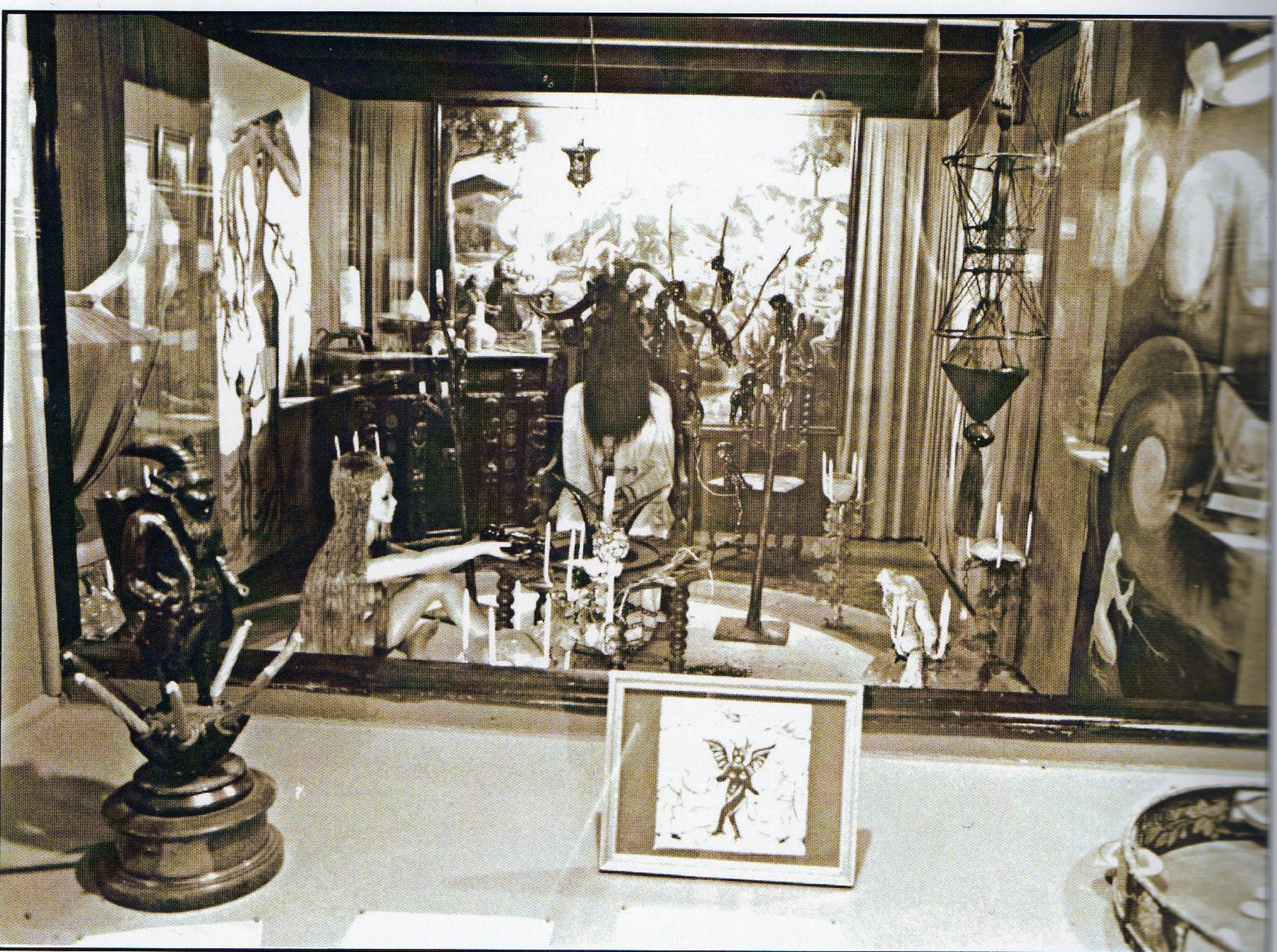
Horned God tableau 1996
One of the main objectives in the Museum’s transformation was the removal of the rather disturbing (to some) and sensationalist ‘Dennis Wheatley style’ tableaux. These incidentally were fascinating to deconstruct, as some very unusual and enigmatic items came to light which wouldn’t have been seen by the average onlooker passing by. Graham had some very definite ideas of what he wanted to put in their place and a reconstructed Wisewoman’s Cottage was top of the list.
Although Graham had to introduce and purchase a lot of new materials to replace old, outworn things, he wanted to use recycled materials whenever possible. This not only fitted in with his environmentally friendly ethos, but he felt that this would have been the way that a wisewoman would have acted – utilising and reusing the materials available to her. He was absolutely right – at least as far as this particular wisewoman is concerned. 🙂
I remember that there was a lot of discussion about how to get sufficient stones for the building of the cottage walls and how costly they were to obtain. Graham admitted to me that after he had seen where I lived, it gave him inspiration for the Wisewoman’s Cottage planned for the Museum. Just so that you can see what he meant, here’s my cottage as it was back then:
My cottage in West Cornwall
Later that same night there was a storm at sea which managed to find its way into the inner harbour, because when Graham and Liz woke up the next day they found that a huge pile of stones had been deposited by the Museum door by the thrashing waves. It appeared that the wind and sea gods had heard of their plight and had provided what was needed!
Graham and the team set to with gusto to create the inside of the Wisewoman’s cottage with the stones, wood and window frames recycled and/or found in the local dump and any skips they came across on their travels. Once the ‘grunt’ work was achieved I was assigned the job of covering the walls with whitewash and painting the woodwork. At one point Graham remonstrated with me that I was doing too neat a job and to roughen it all up a bit!
Once the cottage was starting to take shape, Graham told me his plans to have a mannequin created of an old woman around age 70 years to represent the wisewoman. He was going to call her Joan in honour and in remembrance of Joan Wytte the Guardian of the Museum (another story!) Graham then asked me whether I would be willing to narrate a soundtape of charms as he specifically wanted a wisewoman to be the voice of Joan on tape. It would mean travelling up to Hampshire to Graham’s friend who owned a sound studio. I readily agreed to this and plans were made to travel within that week.
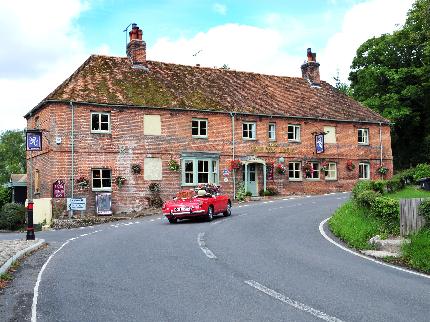
In the end, four of us travelled up to a small village called Wherwell in Graham’s old van. After a long and bumpy journey, (I think the suspension was a bit dodgy!) we arrived at the White Lion and had a few well-deserved pints and a bite to eat.
The White Lion Inn, Wherwell
The next morning at breakfast we were introduced to a couple of people I hadn’t met before, but who I still know and occasionally see today. It was Paul Broadhurst and Vivienne Shanley. Paul is well-known in the dowsing world as he used to team up and co-wrote with the famous and beloved dowser from Cornwall, Hamish Miller. Vivienne, who was Paul’s partner at that time, was an accomplished artist who has produced many fine works of art, some of which can still be found within the Museum. For example, a beautiful presentation of The Wheel of the Year:
The Wheel of the Year by Vivienne Shanley
Apparently our services weren’t required until later in the afternoon whilst the studio was being prepared, so we were free to explore the village – which we duly did. There was no question that Wherwell was very picturesque, however as we wandered around the lanes and then the surrounding fields and meadows there was this distinct feeling of unease bordering on unreality…and then the penny dropped. It was Fran, a member of the team at that time who pointed out that in the fields there was a huge amount of dead wood lying around, which down our way in West Cornwall wouldn’t have lasted five minutes. It would have been gathered and collected ready to be stored for kindling and logs for the winter. When we made our way back to the village lanes and walked past all the cottages, we noticed that there were logs stacked ready for open fires and log-burners – but they were uniform and neatly stacked, obviously delivered rather than harvest the same from the fields a few yards away.
Wherwell Cottages
When we looked closer, we could see that the thatch and surrounding gardens were manicured and well-controlled – even the climbing ivy was chopped off in a straight line in an attempt to regiment and tidy up nature. We realised that this was one of the places that had been taken over by the affluent who loved the idea of a country idyll often seen in copies of Country Life. They lived in what used to be peasant and farm workers cottages, probably turfing out the locals who now were forced to live on council estates or in urban poverty. It’s an elite fashion craze followed by folks that I call ‘Aga Louts’ or the ‘Green Wellie Brigade’! I heard that in Knightsbridge, London where monied people drive around in needless (considering the terrain) 4 x 4 landrovers known colloquially as ‘Chelsea Tractors’, that they actually use spray on mud to make it look like they’ve been driving across the countryside! I was dumbfounded when I first heard this – and I’m not entirely convinced that this is true…maybe it’s an urban myth (or should that read rural myth?) A perfect example of approbation by the rich of what used to be a peasant/working class culture. This has been mirrored in the occult world too, in my opinion, but that is another story for another day.
Back in Wherwell it was time to attend the recording session. Firstly there was the Pagan Chants for background music to the Museum which was to be performed by Liz Crow and her friend Heike Robertson which was worked on and successfully completed after about an hour or so. Then it was my turn.
I had my script of sayings and charms compiled by Levannah Morgan which I had familiarised myself with. I am a trained theatre performer, but in one sense I didn’t have to act as such because I was already a working wisewoman. All I had to do was add a few decades to my age as I was in my forties at the time. Fortunately to all concerned I managed to record the whole script on the first take and I was just about to climb down off the stool I was perched on, when Graham’s voice came over the tannoy system -“Can you give us a selection of cackles please Cassandra?” I have to say I was not expecting this, but duly gave them what was asked and then we were all released from our hours of intensive work and spilled out like naughty schoolchildren into the garden outside.
Graham and his friend said that they needed to spend the next day editing, adding sound effects and working on the tapes so we were left to our own devices. Me, Fran and Liz went for a long, relaxing walk down a wooded lane to find what was locally known as the Witch’s Cottage. It was situated as per tradition right on the outskirts of the village far away from any other dwelling. It was a lovely spring evening and Liz gave us a beautiful rendition of ‘Lady of the Woods’. She has a unique poignant quality to her voice and is especially skilled at singing laments.
When we returned it was time for dinner which was followed by an evening at the White Lion Folk Club which was very entertaining. Me and Fran were doing our best to remain upright on this ancient leather sofa that dipped in the middle rather alarmingly – so much so, it felt that you were on one of those Waltzers that spin around at fairgrounds. Mind you, this was probably enhanced by the many excellent real ales we sampled that night! The evening was being facilitated by a rather bossy woman who could only be described as a ‘born-again Redcoat’! You know the sort – they insist that everyone does a turn, in this case, either singing or playing an instrument. Quite frankly Fran and me were incapable of performing anything because we were giggling so much. This seemed to make this woman even more insistent…which made us laugh even more and…well I think you get the picture! In the end she gave it up as a bad job and moved on to someone else, much to our relief and I’m sure to all the others as well!
The next day I emerged rather bleary-eyed. I was sharing a room with Fran and what I didn’t realise was that she snored – very loudly and erratically. I didn’t get much sleep so I was pleased to hear that we were visiting nearby Winchester that day. This gave me the opportunity to purchase some ear-plugs – and I haven’t travelled anywhere without them since!
Before that we visited St Catherine’s Hill where there was a huge labyrinth cut into the turf on the summit of the hill. I spent a spell-binding 20 mins walking that mazed path and, as usual when I do such things, felt my energy and consciousness shift into another level.
St Catherine’s Hill Labyrinth
Winchester is the ancient capital of Wessex and you could feel history all around in spite of a lot of 21st Century trappings crowding the space. I was entranced by Winchester Great Hall with its famous Round Table and was amused to find when I emerged into the yard, Liz madly rummaging through a skip she had found there. She emerged victorious with yet another foraged prize for the Museum. 🙂
The Great Hall Winchester
Soon it was time to return to Wherwell and to Graham who was well pleased with how the sound tapes had turned out. We all returned to Boscastle that night battling through a seriously thick fog to the Museum, tired out but with a strong sense of achievement.
A few weeks later the commissioned mannequin arrived and was carefully and appropriately dressed by us girls and there was Old Joan ensconced within her newly crafted cottage and looking very much at home. I have to admit that I was startled by her appearance at first because the finished Joan bore an uncanny resemblance to Rowena Cade (Creator of the Minack Theatre) who I had nursed about fifteen years ago. It was all feeling a bit weird and deja-vu ish, especially when the soundtrack started up. I felt like I was in the middle of an episode from the Twilight Zone!
Rowena CadeJoan in the Wisewoman’s Cottage
I have included this link because this film commissioned for the Museum wonderfully conjures up the atmosphere of this unique place – it also contains some excerpts of the original Wisewoman tape.
So here we are back in 2015 and things have moved on. Graham has handed the Museum on to a new owner who is redesigning a lot of the presentation of the exhibits into a more up-to-date genre. Joan’s voice is now different and is now more motherly and I suppose as a result, more acceptable/accessible – although to be honest I have heard some call it “a bit like Jackanory”. I guess in comparison I would have sounded something like Granny Weatherwax (without the cackle!) but I make no apologies for being ‘Old School’. That’s the one thing we can always guarantee – All Things Will Change. 🙂
Update – Candlemas 2019
Several months ago Simon Costin, presented me with the last remaining copy of the Wisewoman Spells and Charms soundtrack that was created for Joan’s Cottage in the Museum of Witchcraft and Magic in 1997. Recently, Laetitia had one of her brainwaves…
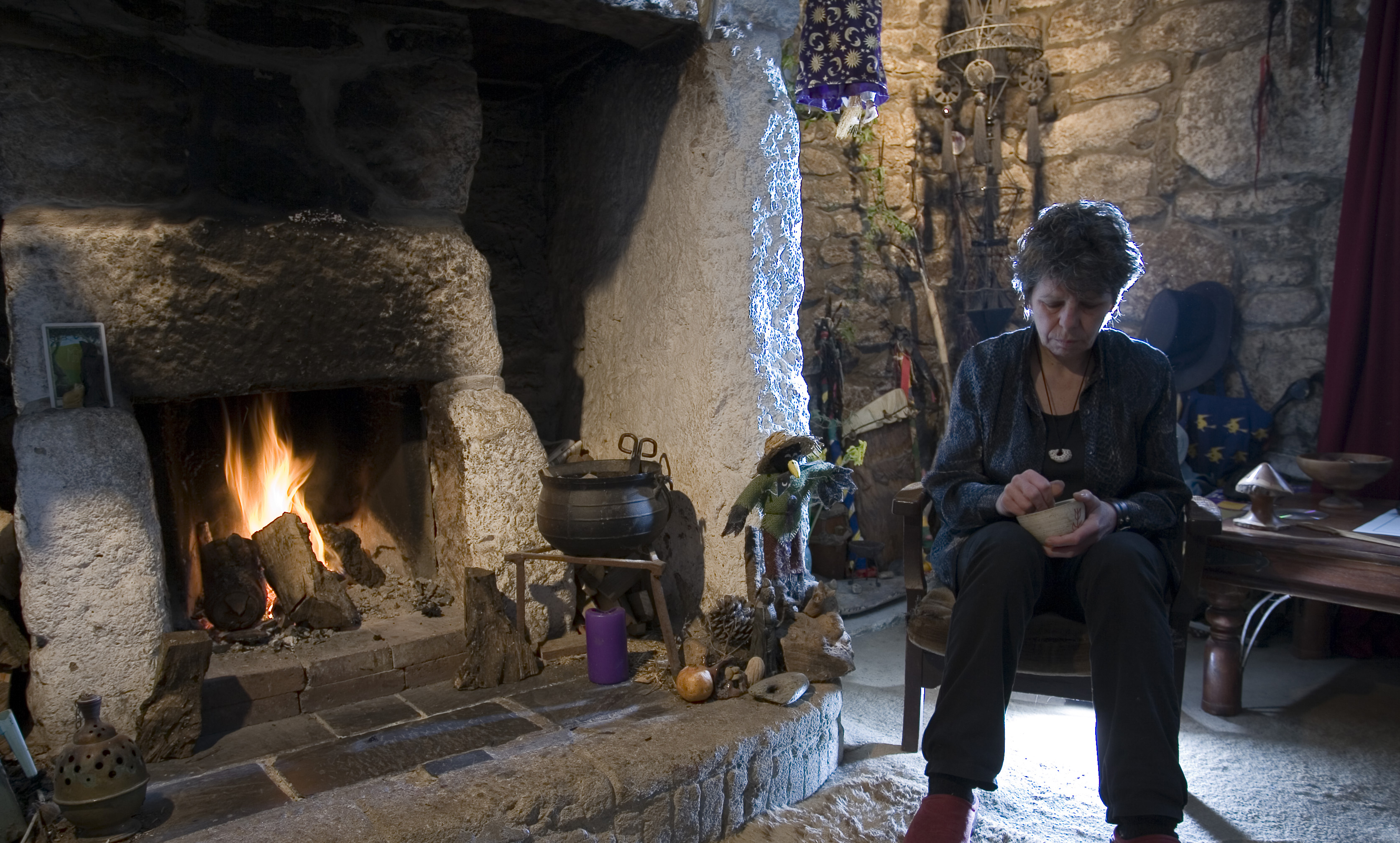
There are many people who have bewailed the loss of the original soundtrack, and those who have yet to hear it. Being that the CD is no longer in the public domain we thought we would create a video filmed in my cottage using the soundtrack in the background whilst I worked at the hearth. I’m nearly 70 now so much closer in age to what I was attempting to portray all those years ago. The footage is not of the highest quality due to the spirits as usual playing around but then I’m used to that sort of thing when I work. However, it is atmospheric with no gimmicks or techno-wizardry to distract from the energies evoked. Here’s the finished video – we hope you enjoy it.
Remember this picture? It was taken at the end of last year’s All Hallows Gathering where we were taking refuge from the elements that raged whilst we were visiting the local hostelries in Tintagel with our Osses and accompanying band of revellers. So what were we up too? Someone suggested that the photo resembled an Agatha Christie denouement which made me laugh, however we were plotting …..! As a result of this I am delighted to be able to present to you the result of our scheming and proudly present:
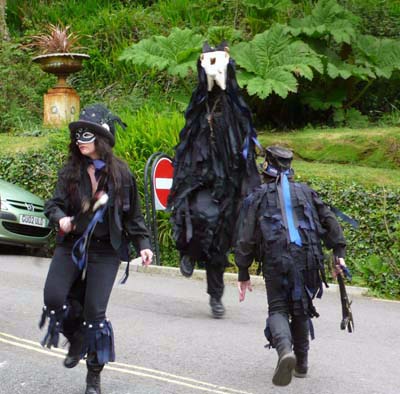
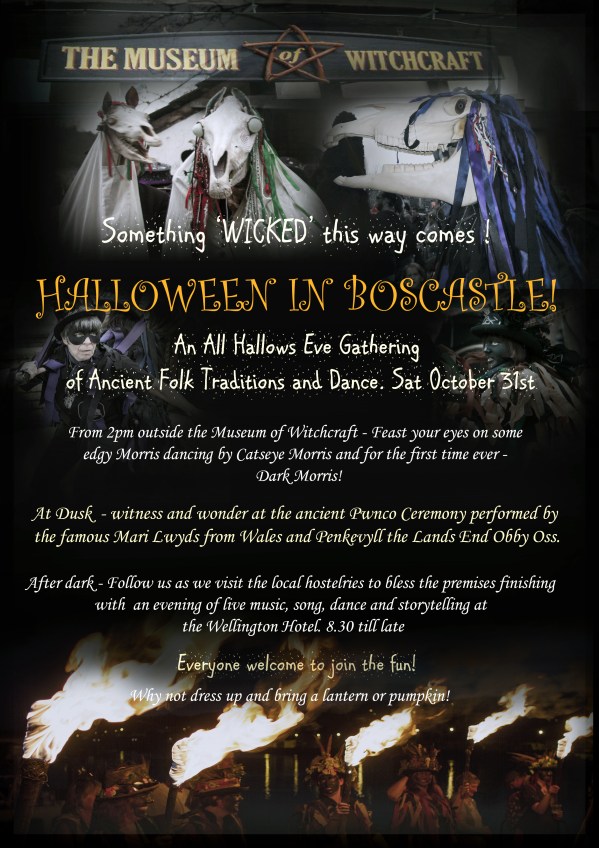
A special Morris side named Dark Morris has been formed specifically to perform at Halloween, made up of accomplished dancers and musicians from various sides from around the country. We felt that this name conjured up the appropriate energies for All Souls night and was a suitable homage to the sad passing of Terry Pratchett who first coined the concept.
“DARK MORRISIn the spring, on Mayday, Morris dancers “dance the sun up” lest it fail to warm the land for the coming summer. This custom is widely observed across the Multiverse and especially on the Discworld, where the threat of stories and legends is real and such rites are more than just quaint old customs. Mayday is a festive occasion and many will drag themselves out of bed before dawn to watch and cheer on the dancers and the sun. Later in the day, perhaps after a nap, there will be more dancing, Morris as well as the maypole, with feasting and frolic and beer.
On or near the first of Ember there is another dance, the last of the year. There is no crowd of cheering spectators, no merriment, no music, no sound. The dancers trade their bright white beribboned costumes for black shrouds and perform in darkness and silence without bells, sticks or swords (or better, with bells of octiron that create a lacy counter-tinkle of silences}. This is the Dark Morris, without which winter may not arrive to complete the cycle, water the land with snow and prepare for the renewal of spring. Winter begets summer, death begets life, and a city-sized sun that travels faster than its own light needs all the help it can get.”Wintersmith – Terry Pratchett
The Museum of Witchcraft are looking forward to seeing everyone on Halloween and they fully support the visitation of the Osses who will be coming to perform the old tradition of pwnco to bless the premises. Later on the same evening there will be a Candlelight evening to view the exhibits – very atmospheric I would imagine. We, however, will be carousing around the local hostelries in Boscastle with the Osses ending up at the Wellington Hotel. There we will be performing from 8 till late providing live music, song and storytelling.
The word is out now and already over 100 people have said they are coming and we will be expecting lots more. Will you be one of them?
Over two years ago my partner Laetitia set up a Facebook group for me called Village Witch. It was specifically created to be a forum for anyone who had read my book and wanted to ask questions about it. Here’s the general description:
This group is for discussion about the book Village Witch, the life and work of Wisewomen. Feel free to ask any questions relating to the book and Village Witchcraft, Folk Magic and work within a village Community. The emphasis will be on down to earth practical application of Cunning Craft.
Village Witch
For a long time not much was asked and apart from the occasional, albeit positive feedback from the members, there has been a lack of interesting threads to follow. However, just recently this has begun to change. The other day I was asked about one of the spells that was mentioned in my book called ‘Pinning the Devil’. The querent wanted more detail hence this particular posting! Here’s the details of the spell as lifted from my book of charms:
Spell for Finding Lost Objects
AkaPinning the Devil
Write on a small piece of paper the object that you wish to find.
Take a long pin, a hatpin is ideal, and run your finger down the pin towards the sharp end speaking aloud the name of the lost object.
Continue chanting this over and over, building up the energy until you feel that you can’t put anymore energy into the needle.
Then thrust the needle through the piece of paper and stick it on the back of your sofa/settee.
Leave in place until the object is found.
The aforementioned Devil, I believe is referring to mischievous house spirits who delight in hiding objects and later revealing them in the most unlikely places. I decided to also consult a colleague of mine who I know utilises this particular example of folk magic. Her name is Seldiy Bate who is a renowned psychic, an accomplished astrologer and a mine of information concerning intriguing magical spells. I asked her views upon ‘Pinning the Devil’ and here is her response:
This is a tradition that was in almost every branch of my family. The way I was taught was that you write the name of the lost object on a piece of paper and then you pin it violently to the back of the sofa with a hatpin (or a pin if no hatpin available). Once the object returns, you remove the pin. You say “I pin the Devil” when you stick the pin, and I would imagine it is to fix the object into your possession and perhaps to spur the house spirits into action, whether it’s a goad to get them to return your property, or a punishment, I am not sure! Perhaps it’s to make them squirm until you remove the pin, which only happens when you get your stuff back!
Some people do it without the piece of paper, just by naming the lost object. Some say you have to take the pin and circle it anti-clockwise over the arm of the sofa, whilst visualising the lost object, you say “I pin the Devil! Return to me my …. (name the lost item)” as you stick the pin in the arm of the sofa (a bit dangerous for an unsuspecting guest!). If you don’t own a sofa, use a cushion. I’ve done that with good results.
As with most folk magic I would imagine that the Gods, spirits or daemons got demoted into being called the Devil over time. It’s funny how some people who wouldn’t dream of mentioning the Devil in any other context seem to be ok doing this spell!
It’s interesting and ironic to consider how much essentially Christian imagery is used in so much of folk magic. I say ironic because so many people associate witchcraft and the like with paganism and like the well-known Gospel song – “It Ain’t Necessarily So!”. Although it is my belief that witchcraft is not a religion, folk magic/cunning craft utilises whatever is around that is effective and that includes belief systems. When the majority of your clientele comes from a Christian background then it’s not too surprising to see that symbolism creeping into the spellcraft. This is why so many of the old charms incorporate, Mary Mother of God, the Devil and the Four Apostles. The flip side of this of course is the realisation that given this, you can understand why some ‘Ministers of God’ see such practices as Black Magic and Satanism!
However, as I have mentioned in my book I believe the Devil/Satan/Lucifer, or whatever you chose to call him, is a scapegoat figure deliberately created as a symbol of projection. It’s so much easier to project one’s fears, anxieties and insecurities onto a blame figure rather than take responsibility for one’s own shadow. This why people who are fanatical, fundamentalist Christians live in fear of their own Shadow which they then project onto others, seeing evil in all sorts of people, practices and alternative beliefs, calling them demonic and the work of Satan.
Cunning craft/witchcraft is far more mundane and pragmatic than these sensationalist imaginings, working with ordinary folk to try to help resolve their everyday but important issues and problems. It’s been that way for centuries and probably will ever continue thus!
Yes, Penkevyll the famous Lands End Obby Oss, has made it as Cover Girl to the glossies!
“Out soon – Indie Shaman #shamanism magazine Issue 25. A great time to subscribe – get Issue 24 on subscription and Issue 25 at the end of July at https://indieshaman.co.uk/.
Includes: ‘Cunning Folk’ a chat with Cassandra Latham-Jones;
‘Reconnecting To Ourselves Through The Consciousness Of Plants’ by Davyd Farrell;
‘Horse Scents’ by Hearth Moon Rising;
‘Working with Wolves: The Wolf Life Path Cards’ by Lorenzo Guescini;
Eoghan Odinsson continuing his series on Northern Plantlore with ‘Comfrey’;
An interview with G.W. Bénard;
‘Animals, a shamanic story’ by David Sparenberg;
Some thoughts on telepathy from Ann Fallas and columnist Yvonne Ryves in Shaman Moon;
Book reviews including Itzhak Beery’s ‘The Gift of Shamanism’ and ‘The Toltec Secret’ by Sergio Magaña Ocelocoyotl plus Shamanic Events calendar.
With thanks to all of the above contributors as well as to Mike Chapell for the wonderful front cover photo and wildlife photographer, Rochelle Kent-Ellis, and poet, Chris Roe, for the beautiful back cover. Thanks also to Peter Carter, Rebecca Orford and Jack and Nigel Dugdale for article photography. With special thanks to Martyn Kington for the inspiration and of course not forgetting grateful thanks to proof reader, Martin Pallot!”
I’m looking forward to receiving my copy at the end of the month when it will be added to my Archive. 🙂
My copy of ‘Indie Shaman’ arrived this morning with my article inside. A good quality glossy magazine. If you want to read the rest of the article you’ll have to get your own copy! 🙂
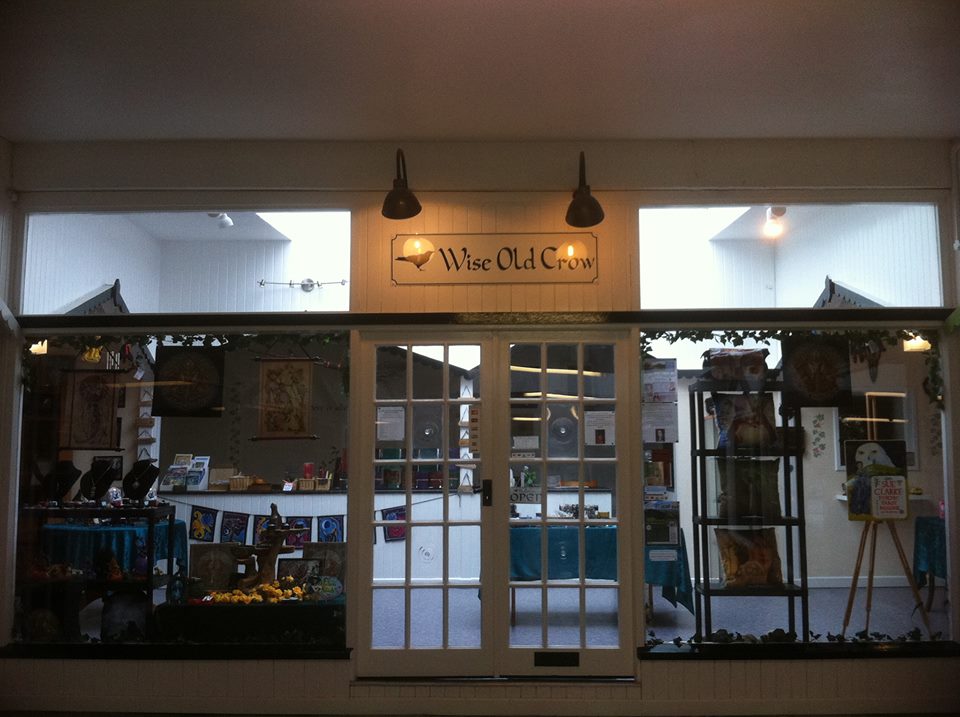
On Saturday 25th July 2015 between 1.30 and 3.30pm I will be at The Wise Old Crow for a Book Signing of the second edition of my book, ‘Village Witch’.
I will be giving a short talk at 2.30pm on life as a village wisewoman and will be available to answer any questions you may have. Laetitia will also be with me who is gifted in mediumship and whose speciality is working with energies of the sea.
Here are links to The Wise Old Crow for any further information you may need:
I do hope that you can join me and Laetitia on this day as we would be delighted to see you all! 🙂
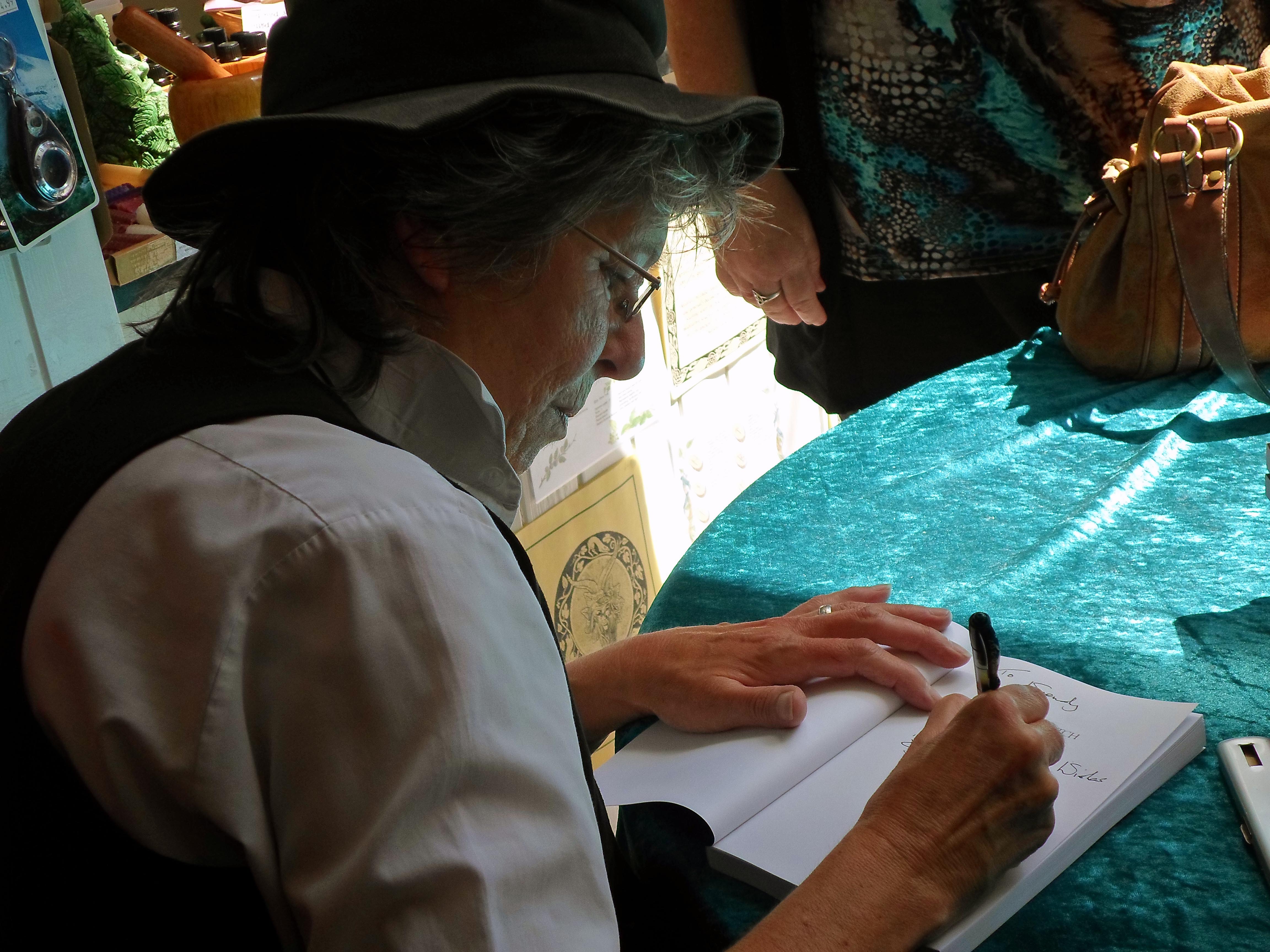
Well, the Book Signing and Talk went very well judging by the feedback we received afterwards. There was a good turnout for the talk and I sold 20 books by the end of the day. As a direct result of this we have had consultancy and workshop requests so all in all a resounding success.
Here are a few photos of the day:
My thanks to Sue Clarke of Wise Old Crow for organising and hosting this event and I have no hesitation in recommending her shop as an excellent venue to others. 🙂
I’ll always remember the very first public talk I gave about my work as a Village Wisewoman. I went through a whole gamut of emotions, and my nervousness conjured up, in my dreams and waking hours in the days leading up to the event, all sorts of imagined scenarios. My doubts and fears concentrated on things inevitably going wrong in some way.
We’ve all seen it happen with others, and in my time I’ve seen many speakers that quite honestly should just stick to writing and leave it at that! However, they are often pressurised by their publishers to give talks in order to promote their books, and I have witnessed first-hand the tortures and mental anguish that they (and their audiences) suffer as a consequence!
Standing up on stage in front of perhaps a hundred odd people is a very lonely and exposed place and can be terrifying. You will be closely scrutinised by everyone in the audience for most of the talk, so appearance really plays an important part. We don’t realise sometimes how our body language and mannerisms can say so much about who we are. Some try to counteract this by hiding behind stage furniture such as lecterns and tables or bury themselves in sheaves of notes that invariably get dropped or muddled up. In this technical age many resort to slideshows or Powerpoint presentations in order to avoid the relentless public gaze. This to a certain extent can work to distract, but equipment is known to be notorious for breaking down at the crucial point, or showing the wrong slide and any machine is only as effective as its operator. Besides which, if you have become known as an author, many folks want to see what the writer is like in the flesh so to speak, so this kind of curiosity is to be expected.
Some advocate staring into ‘the middle distance’ in order to focus and concentrate but often this method produces the effect of the talk being pitched at the audience which isn’t in my opinion very inclusive. I’ve seen this way employed by many lecturers who have swathes of information that they endeavour to instil into their listeners. Unfortunately this can have the effect of sending the audience into a semi-trance because they are not being actively engaged by the talk. No matter how interesting the topic may be, if you don’t have at least occasional eye contact with your audience, then they can either get restless or worse – fall asleep! Fortunately this has never happened to me, yet!
Nowadays most talks are conducted with the aid of a microphone which neatly deals with the problems of voice projection, but care is needed especially with old equipment to avoid feedback howling and the like. Tone of voice, pitch and attitude is also crucial for obvious reasons. No-one wants to be dictated to in any kind of hectoring way, but it’s also important to avoid monotone voices which inevitably leads to monotonous boredom.
I think that most people’s biggest fear of public speaking is ‘drying up’. This can be literal, so it’s always a good idea to have water handy. Take sips only, gulps can cause choking if it ‘goes down the wrong way’ – and watch out for those ice cubes that some helpfully add to the water, they can be lethal! Mostly though, what I’m talking about here is the dreaded mind going blank scenario. This can happen at any time to anyone, and all I can say is that it’s down to the individual personality as to how this is handled. A lot depends on your audience and your relationship with it. It’s always well to remember that (1) you will never please everyone – there will always be detractors, and (2) there will always be some who are there supporting and agreeing with you.
I feel that it is important to allow time for questions at the end, as folk can feel a little cheated if this is denied to them by a speaker rattling on over time. I know that this can be particularly nerve-racking as you never know what people might ask you. If you know your subject thoroughly and are ready to expect the unexpected then you’ll be fine, and may actually enjoy it!
Finally, how did I get on with my first talk? Well, it actually went very well. The person introducing me thought it was a clever idea to start telling the audience some of the anecdotal material that I was going to include later. I was so incensed by this that I forgot my nerves and started with “For a moment there I thought he was going to do the talk for me!” This produced supportive laughter from the audience and I was away and off to a good start. I had formed a rapport which to me is the most important thing to have between yourself and your audience. I loved my subject matter and it showed through my animation.
Reading back, I think I have definitely written on the ‘terrors’ of public speaking. The only helpful advice I can give is:
If you’re passionate about your subject matter, then try and share that enthusiasm with your audience.
Be yourself, whatever that is. It just won’t work if you’re trying to be something that you’re not, because on that stage you will fool nobody, so you might as well be natural.
Following our wonderful visit to Chepstow Wassail earlier in the year, we had made important connections with some of the folk concerned with the Mari Lwyd. These were re-ignited when I received a message from the couple who operate the Y Fari Troellog, one version of the Mari Lwyd. They were coming to Cornwall over Halloween bringing their Mari and asked if we would like to meet up and bring our Oss, Penkevyll.
Y Fari Troellog
My partner, Laetitia, then had the brilliant idea of meeting up at the Museum of Witchcraft in Boscastle and making an event of it. I wrote to the Museum and they agreed to our plans and the next couple of weeks were filled with myriads of emails and Facebook messages flying to and fro encouraging folks to come and witness this historic event. One of the responses we had been from Mari Trecopr – so that was another Mari who wanted to come!
Mari Trecopr
We then decided to extend the Mari event to include All Souls Day and to be spent visiting the hostelries in nearby Tintagel. We sent emails to all of them warning them of our impending appearance and suggesting that if they had any problem with that to get back to us.
We worked on the pwnco ceremony that we would be enacting at the Museum. A pwnco is a rhyme contest between the Mari party and the inhabitants of the household, or in this case, museum. Both parties challenge each other with improvised verses which are traditionally sung as an exchange through the closed front door. If the Mari Lwyd is successful then they are invited in to bestow blessings and good fortune on the building. During this time the Osses are ‘fed and watered’ with alcohol and cake. Many people offer the Mari money to bring luck.
It was decided that in this case we would create our version of a pwnco by making it more of a welcome rather than a challenge as it was the Mari’s first time in Cornwall. We thought that we would enter into the spirit of things by reciting our verses in Cornish, so we contacted the redoubtable Craig Weatherhill for help, and he produced the goods willingly and swiftly. Many thanks Craig!
The culmination to all our plans happened this last weekend when it all finally came together in a wild, slightly anarchic happening. I’ll take you through the experience….
We travelled up from our home near Lands End with certain misgivings and unanswered questions on our mind:
Would many people turn up? We’d sent invites to all we could think of who would be interested but apart from a handful of people, no-one had really committed themselves to coming.
Would we be able to perform our part in the pwnco ceremony adequately? Our contribution was written in Cornish and had to be sung in response to the Welsh verses, and given the busyness of our lives at that time, we hadn’t had any chance to practise.
Would the weather be kind as Cornish weather is notoriously unpredictable?
We all met up in the Cobweb Inn and following suitable refreshment it was time to take Penkevyll down to the Museum. We allowed plenty of time for this as the Oss has to ‘meet and greet’ on her way!
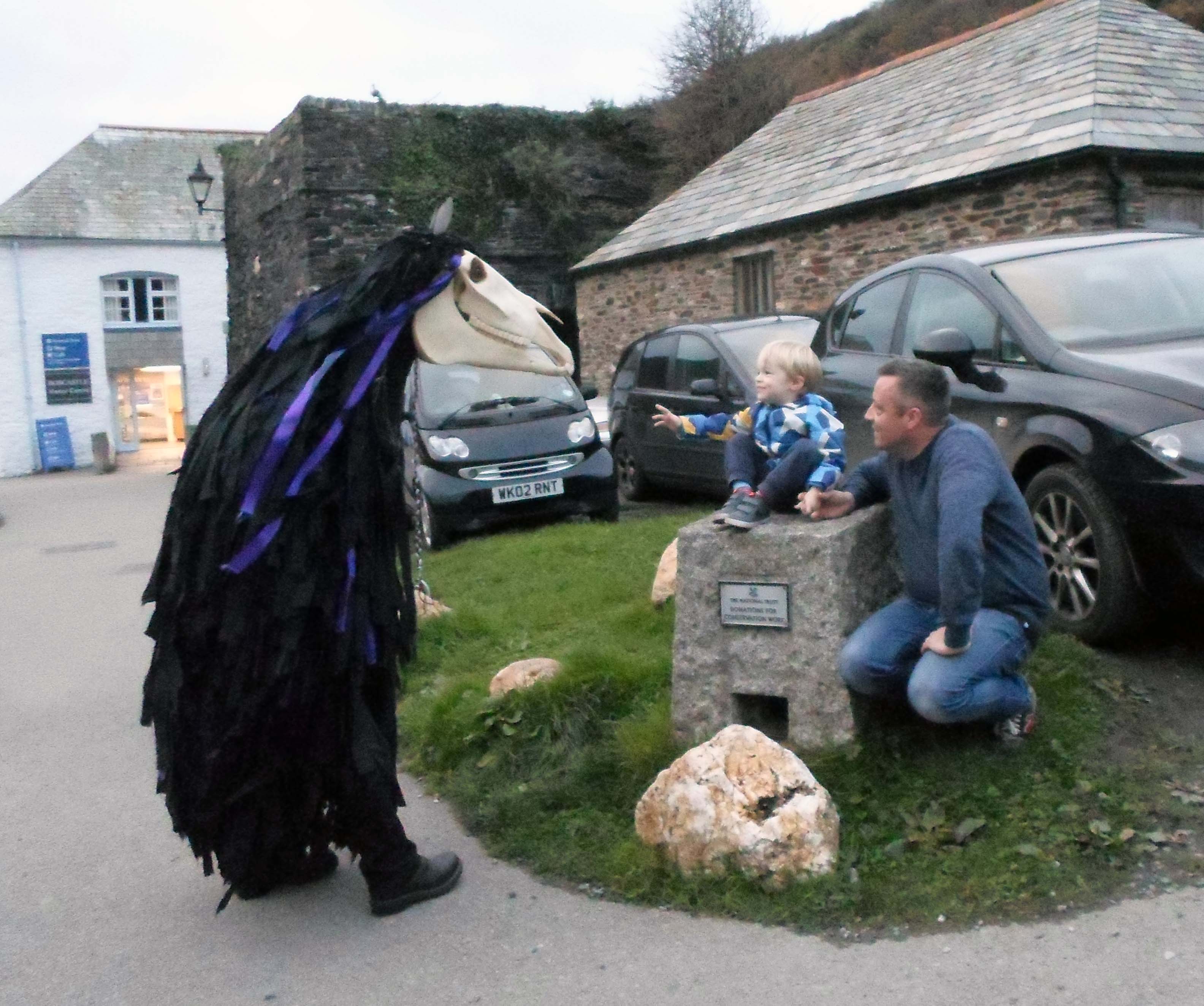
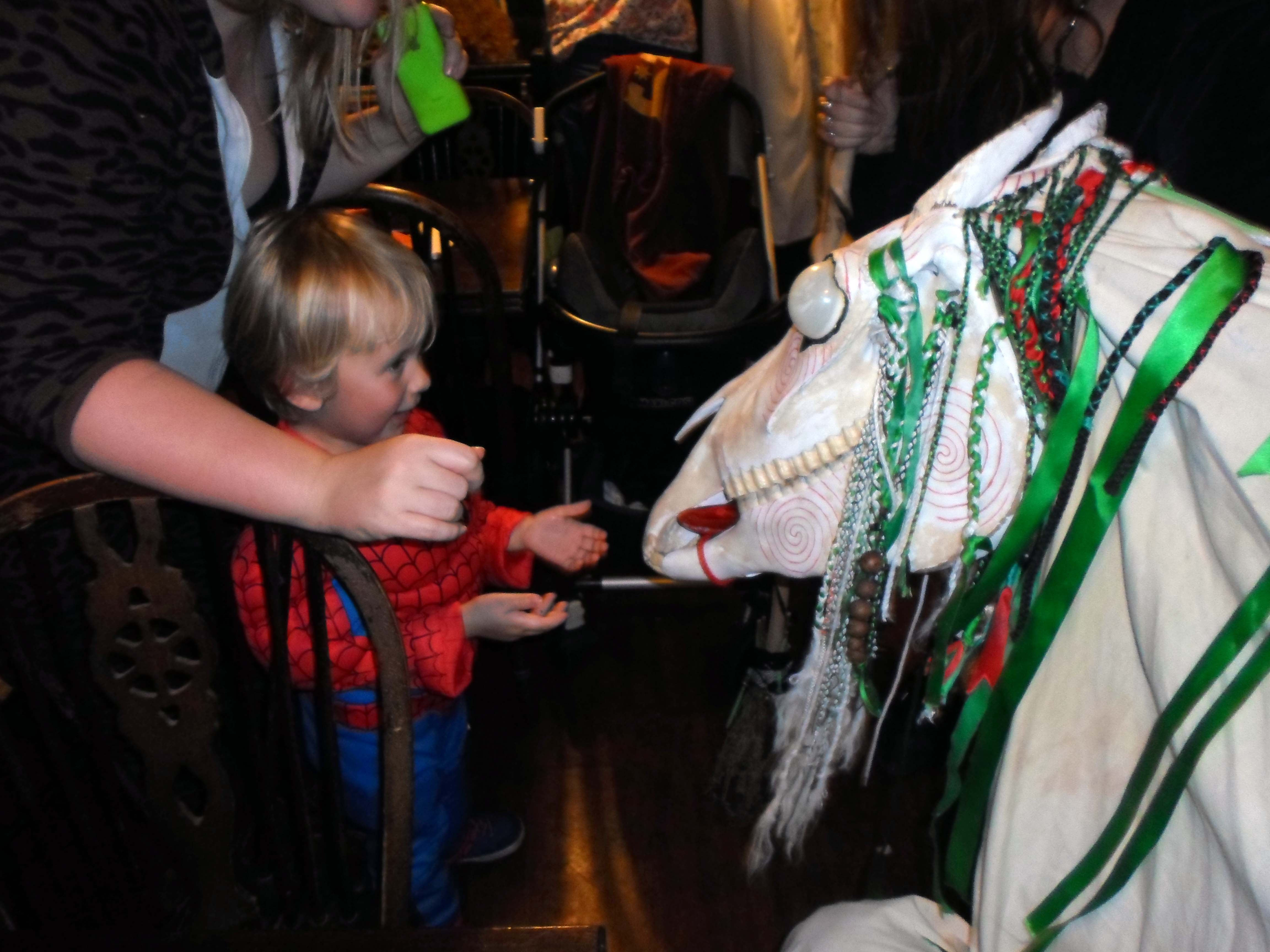
Most children love Penkevyll!Penkevyll always shows appropriate respect to the Elders.
Once inside the Museum we met the managers, Judith and Peter, and prepared ourselves for the arrival of the Mari’s. We hadn’t long to wait. Before we knew it there was a great knocking on the front door and the Mari party starting singing their verses of the pwnco in Welsh.
Singing the Pwnco – Photo credit: John IsaacMari Trecopr – Photo credit: John Isaac
We answered, rather haltingly in Cornish, a final verse was exchanged and the door was flung open and the Mari Lywds were welcomed in!
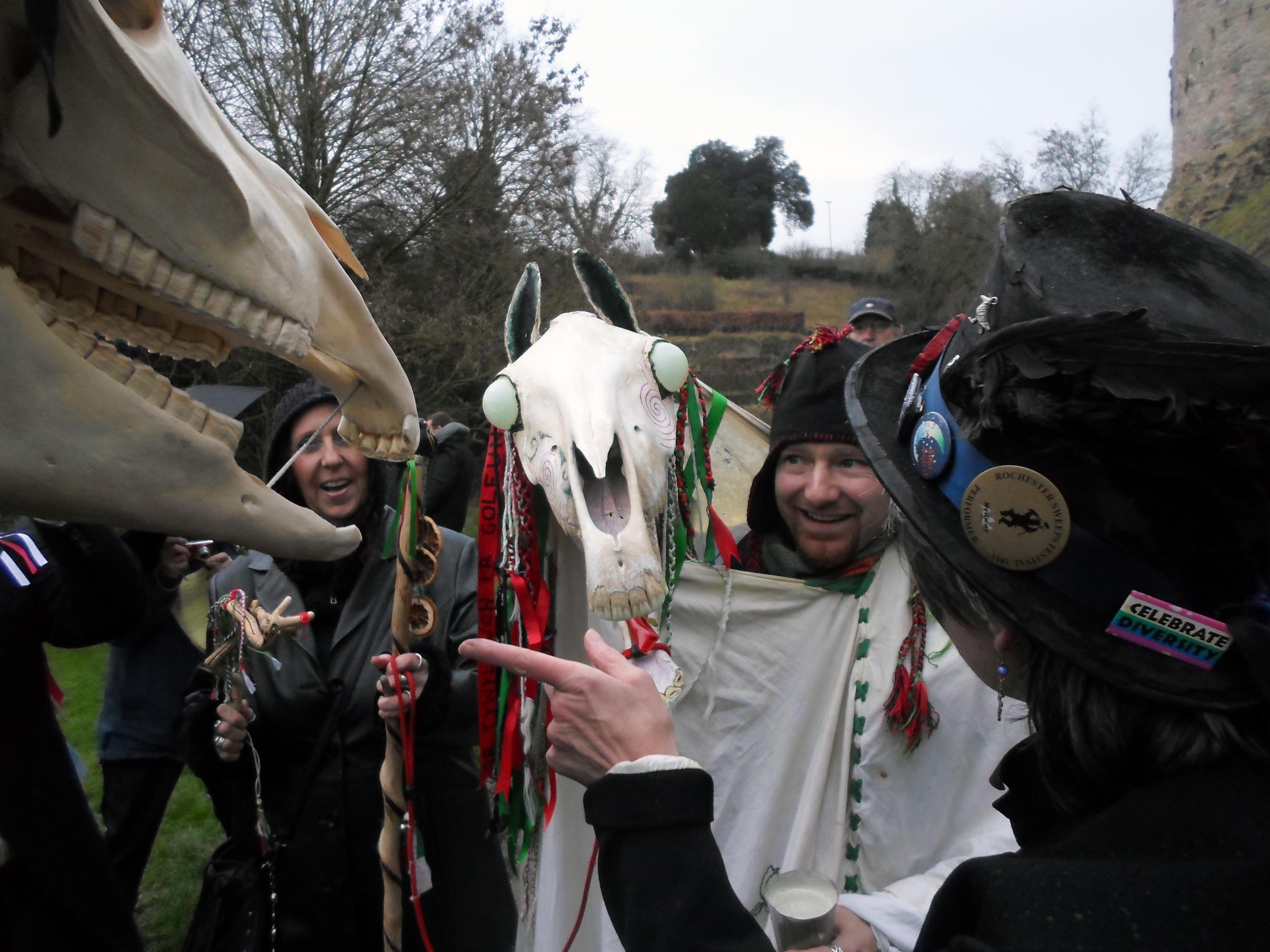
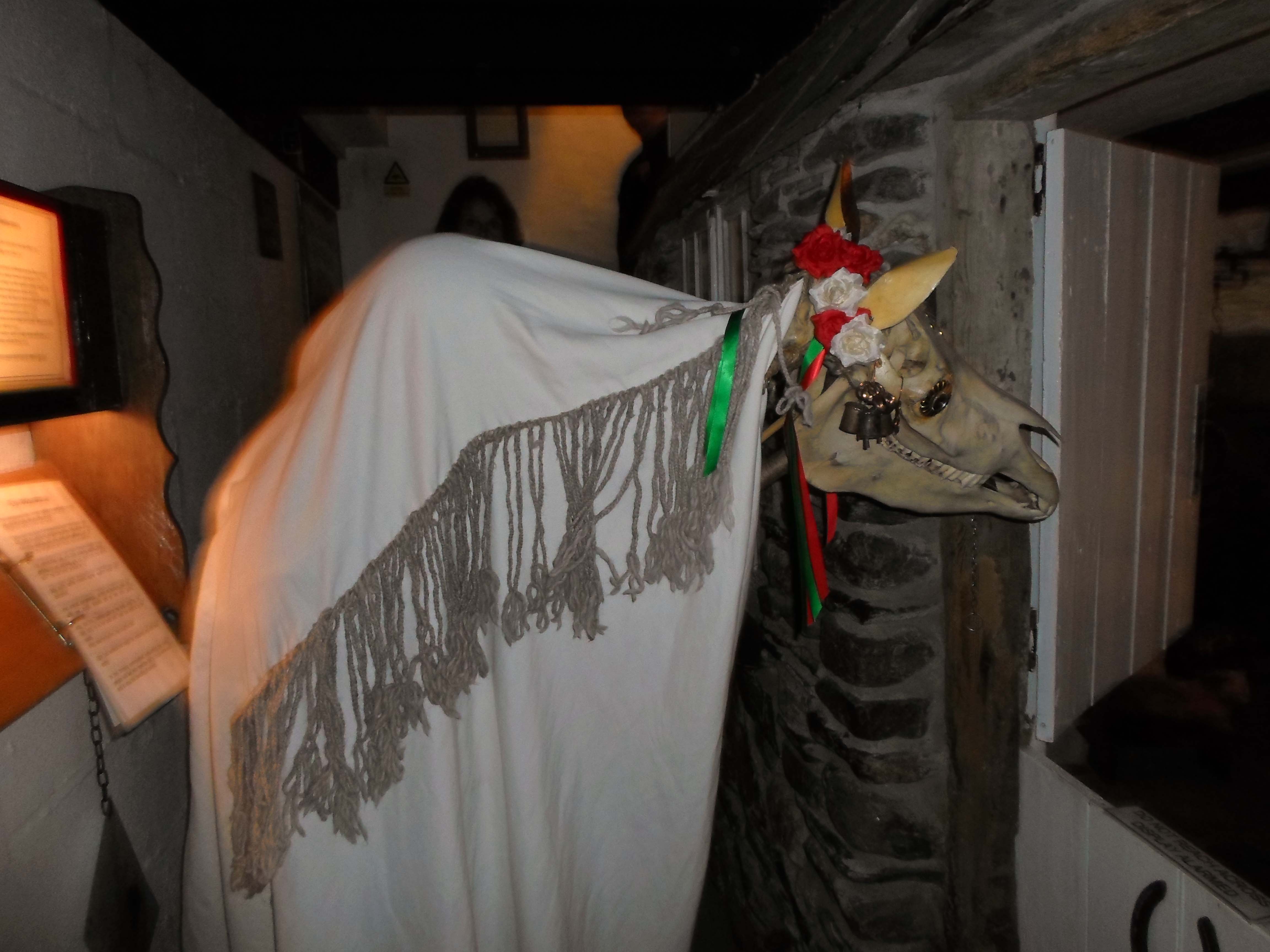
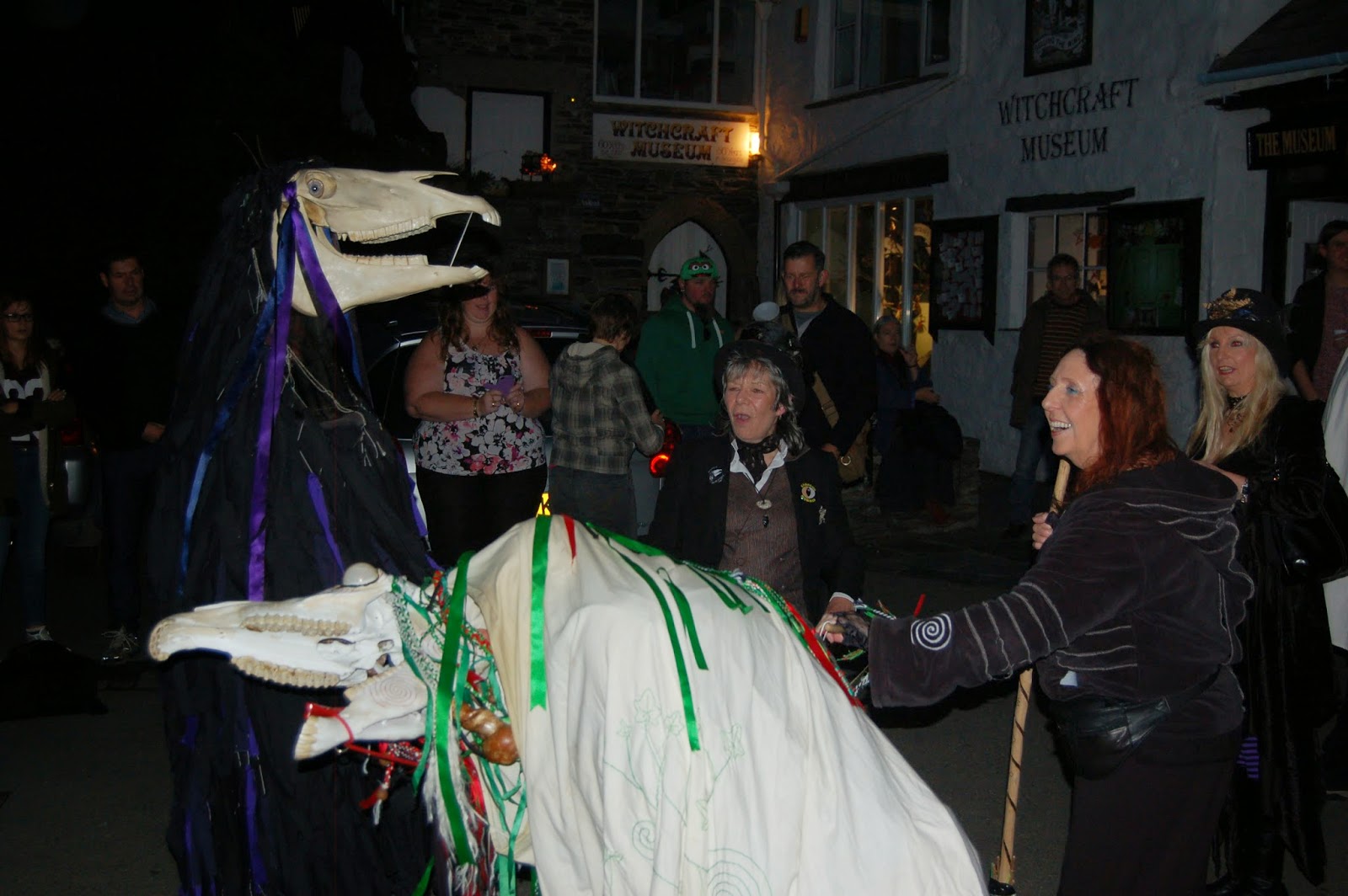
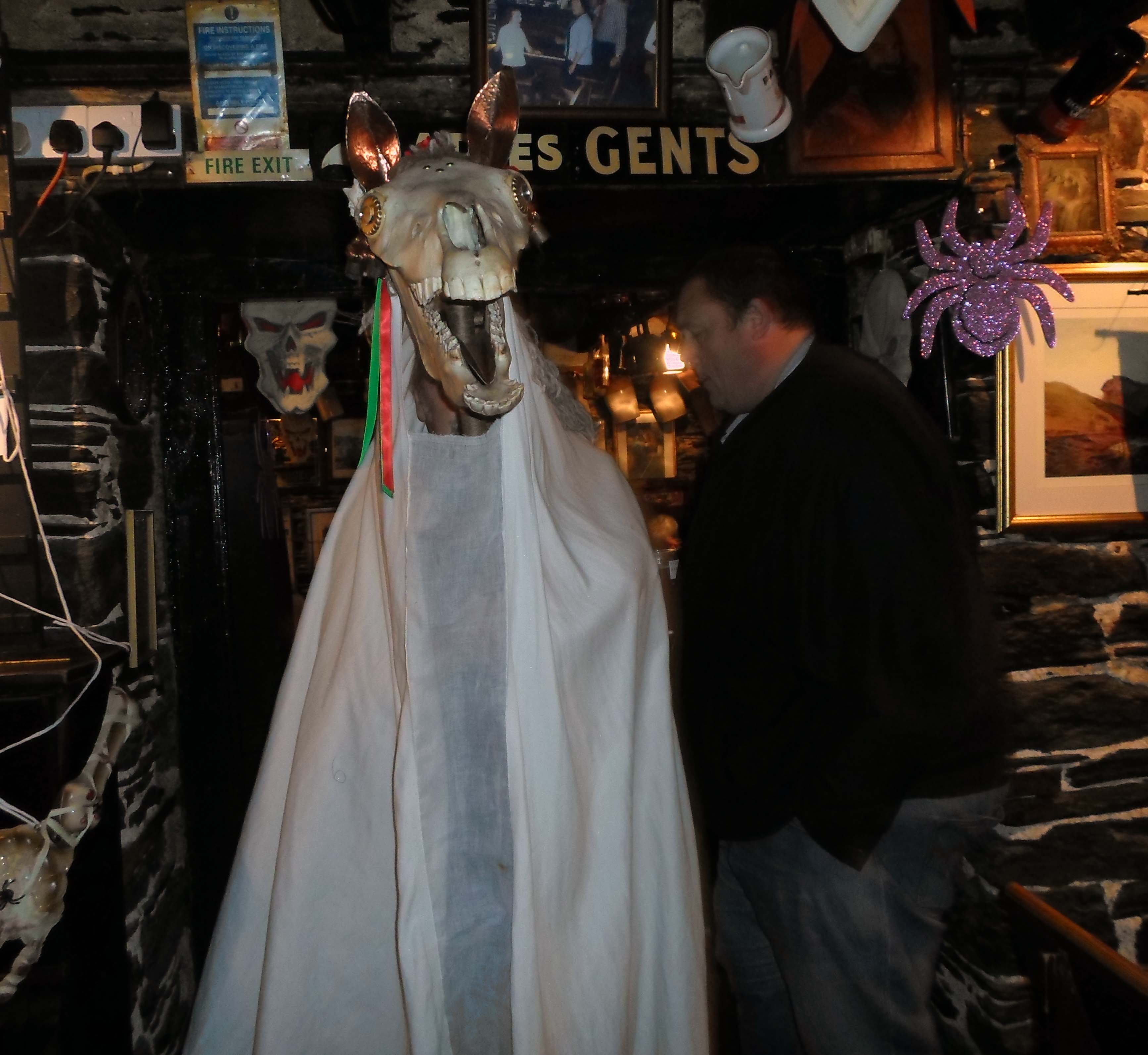
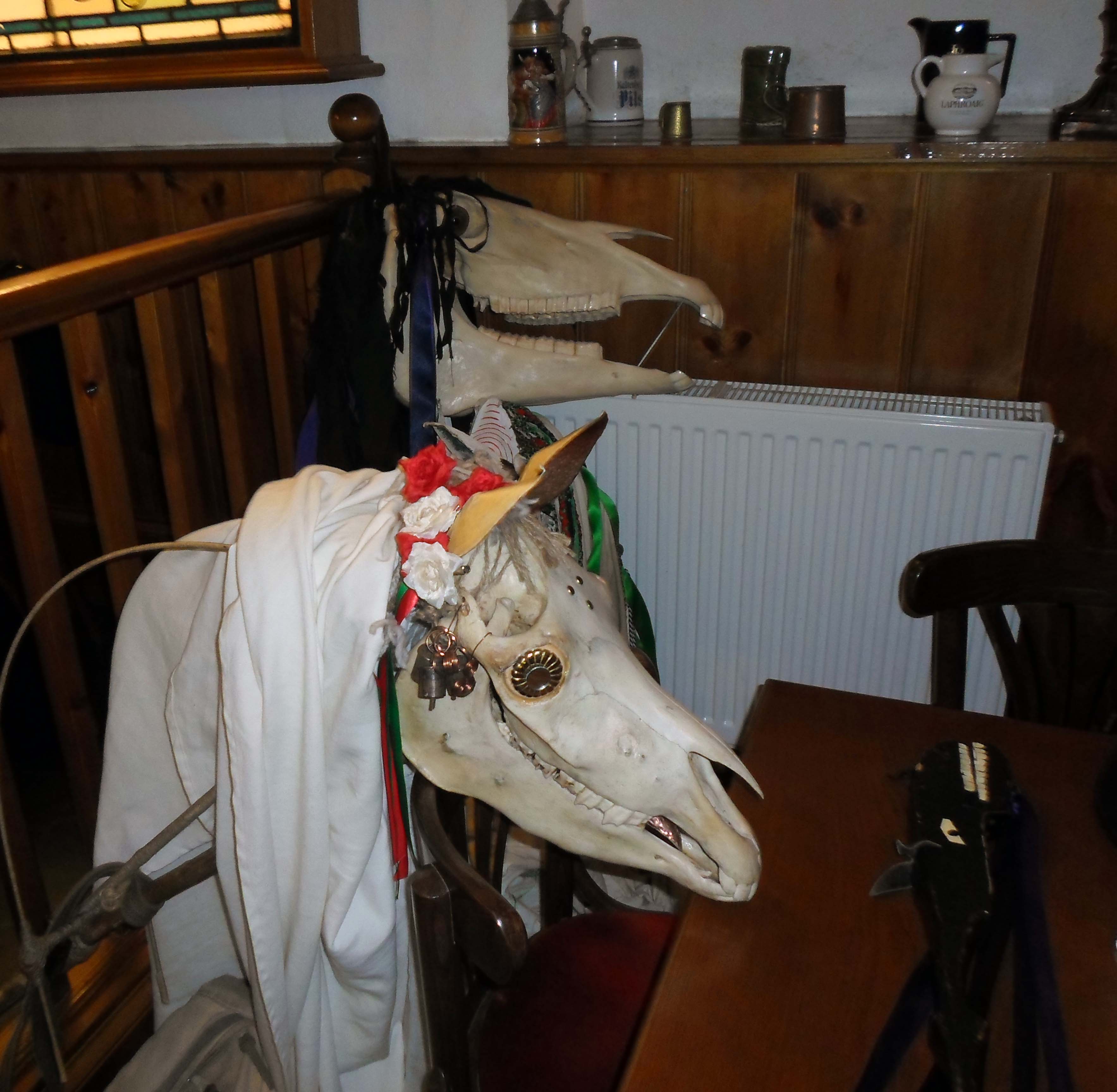
In order for the Mari Lwyd to properly bestow blessings on a building, they have to thoroughly investigate every nook and cranny. So you can guess what fun the Osses had doing that! As you can see from the following photos.
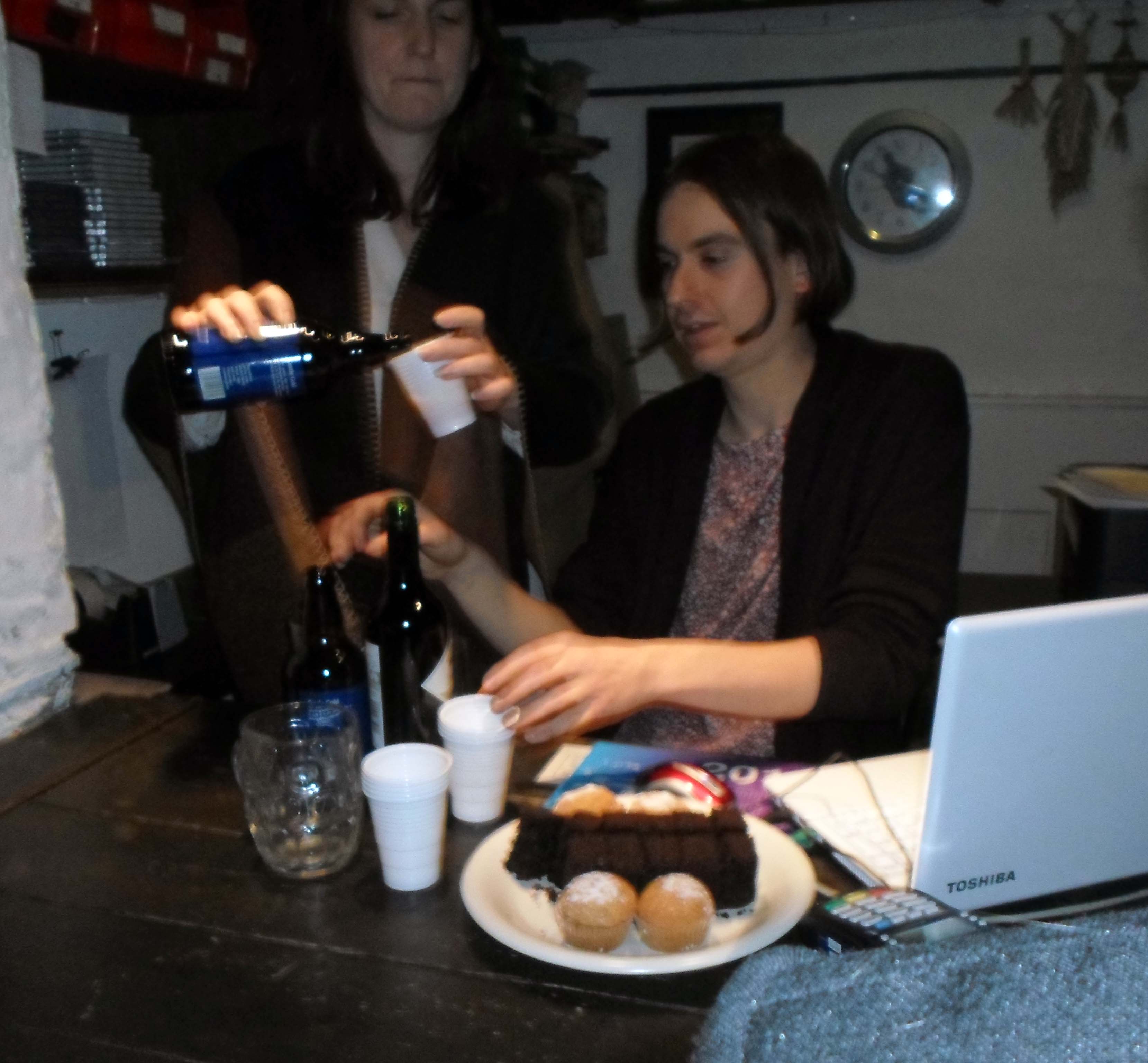
At last it was time for the traditional libations and so everyone was ‘fed and watered’ with alcohol and cake.
Needless to say this was very well received!
It was time to go out and meet our public and see how many folks had turned up to support this event.
Credit: John Isaac
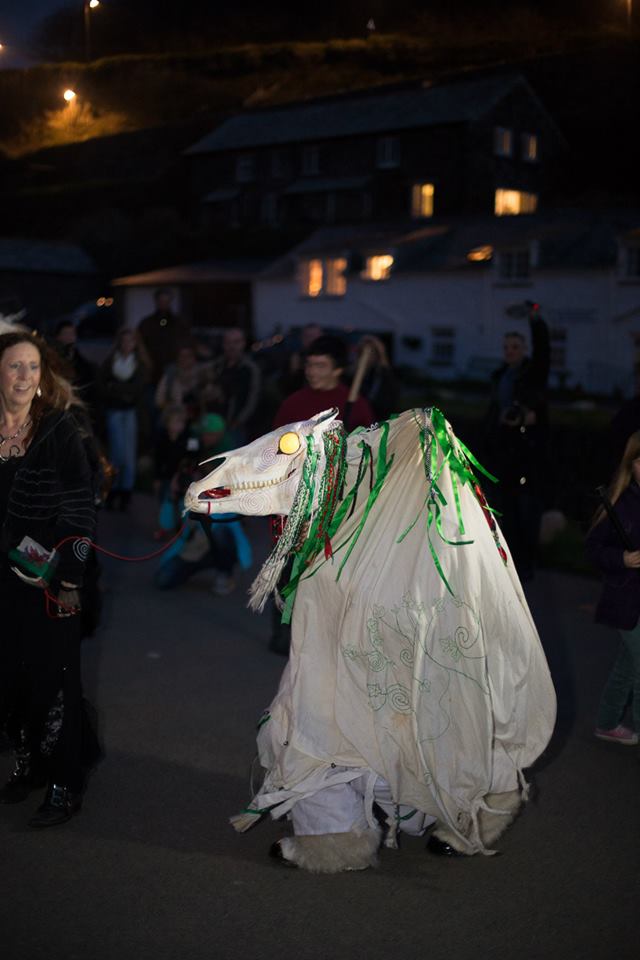
To our delight there were dozens and dozens of people there enjoying the music, dancing and general merriment. So without further ado the Mari Lwyd and Penkevyll joined in with gusto! It was brilliant! 😀
Credit: Museum of WitchcraftCredit: John IsaacCredit: John Isaac
Later on we caroused our way around the Boscastle pubs meeting the locals and thoroughly enjoying ourselves – as you can tell…
…and so to bed!
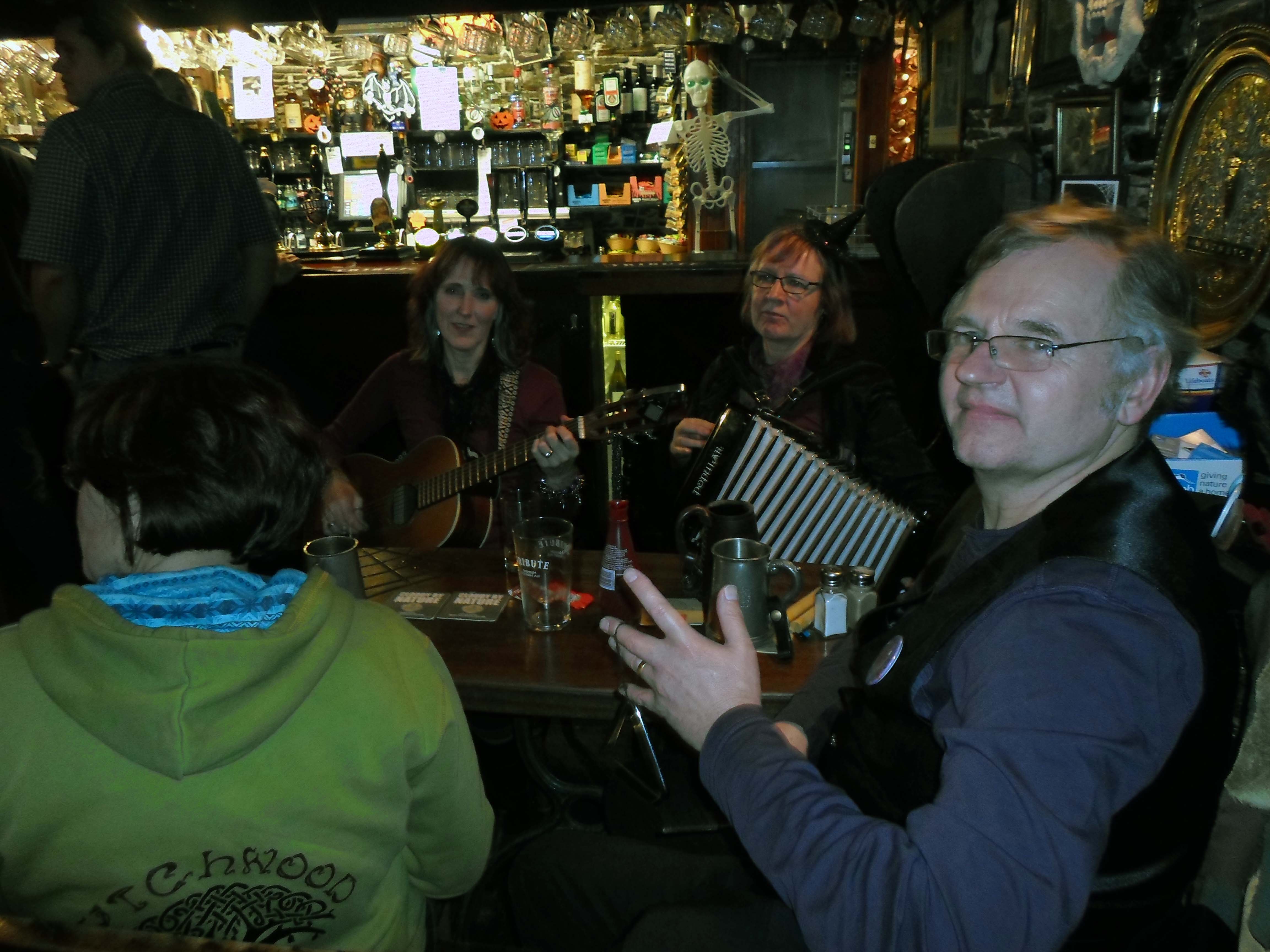
The next day we were joined by more people from Wytchwood Morris. We repeated our visitation to all the hostelries in Tintagel, only this time Penkevyll stayed in her warm and dry stable (rider unavailable), and I was free to join the musicians and enjoy the spectacle of the Mari Lwyd without having to keep an eye on Penkevyll (a full-time job).
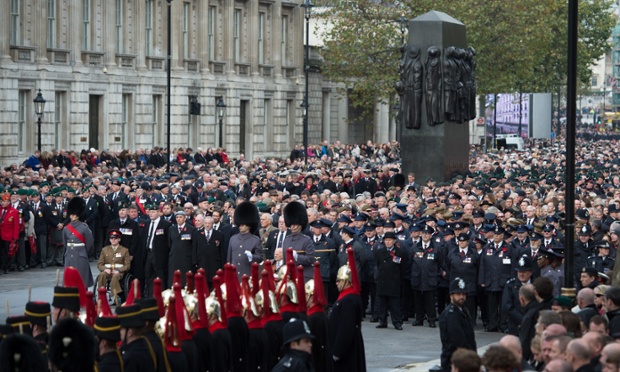
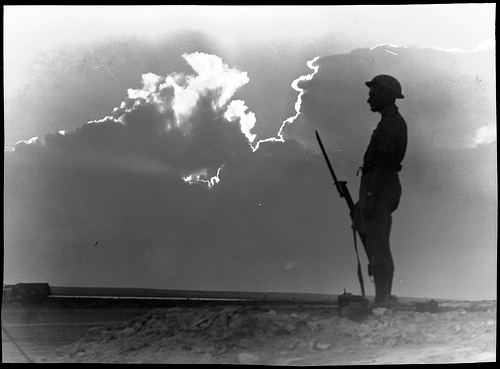
Today on television I watched the Remembrance Sunday ceremony at the Cenotaph. This year was the centenary of the First World War so great importance was focused upon this event. I watched with mixed feelings.
Considering we are supposed to be a nation of ‘stiff upper lips’ we put on remarkably emotive pageantry that is unbeaten anywhere else in the world. For one day the elders in our community are honoured as the narrator describes in respectful, measured tones all that these men and women did for us in the hour of our greatest need. Ordinary folk achieving extraordinary things.
Once all the fervour and rhetoric has died down, these self-same people will become, once again, the invisible generation. How ironic that these people can file proudly past the Cenotaph and be applauded by the crowds, and yet be completely marginalised and ignored by most of society for the rest of the time.
I used to work with the elderly and have seen first hand how so many of them have been literally dumped in nursing/ residential homes, their own homes sold from under them and left to die alone and unwanted. Obviously not every pensioner suffers in this way and some fortunate ones are supported by a loving family, but sadly the majority have been abandoned not only by relatives but also now by the State. Government cutbacks have shut so many care homes and respite centres that the future looks very bleak indeed for our older generation. Is this anyway to treat the very people who fought for our freedom?
During the war everyone had to pull together and learned to help each other out. Times were meagre and there was no room for wastage. Now they are surrounded by greed, fear, indifference and political apathy.
War still continues unabated so was it all just a futile, terrible waste?
This song sung by June Tabor sums up how I feel about this.



































 Grumpy Old Witchcraft