
Anyone that knows me is aware of my deep and abiding fascination with Obby Osses and lately in the last few decades with the Welsh Mari Lwyd. Last year I came across this inspired article by a young man called Kristoffer Hughes who I met at this year’s Chepstow Wassail with his Mari Lwyd. He is an author and a Druid and his Bardship is strong and vibrant. Curl up in front of the fire with a warming drink and enjoy his excursion into the spooky realms of…
The Winter Mare – Mysteries of the Mari Lwyd
By Kristoffer Hughes

Midnight. Midnight. Midnight. Hark at the hands of the clock. Now dead men rise in the frost of the stars. And fists on the coffins knock.
Bright Yuletide lights may lull us into a false sense of security that the dying time is over. It is not. As the year took to its deathbed at the Calends of Winter/Halloween the cycle did not restart immediately, oh no, for the season of darkness is long and biting, the descent into the tomb deep and silent. Dying takes time. Fists on the coffins knock.
As the great wheel of the year comes to a standstill, under the harsh bite of winter, the sun stalls in its progression across the skies of dawn, and nature holds its breath. The promise of spring is held within the magic of the Midwinter Solstice, lights shine brightly to warm the dark nights, and revelry and feasting bring families, friends and communities together in the hope that somehow – that warmth, that joy – will push back the edges of darkness. A mere 3 days later Christmas echoes this ancient magic of hope, new birth, promise and life. And yet this promise is still not tangible, we barely sense it, will we survive? Winter will not release its grip willingly. Will we make it through the dark days to come, will we survive the tempest?
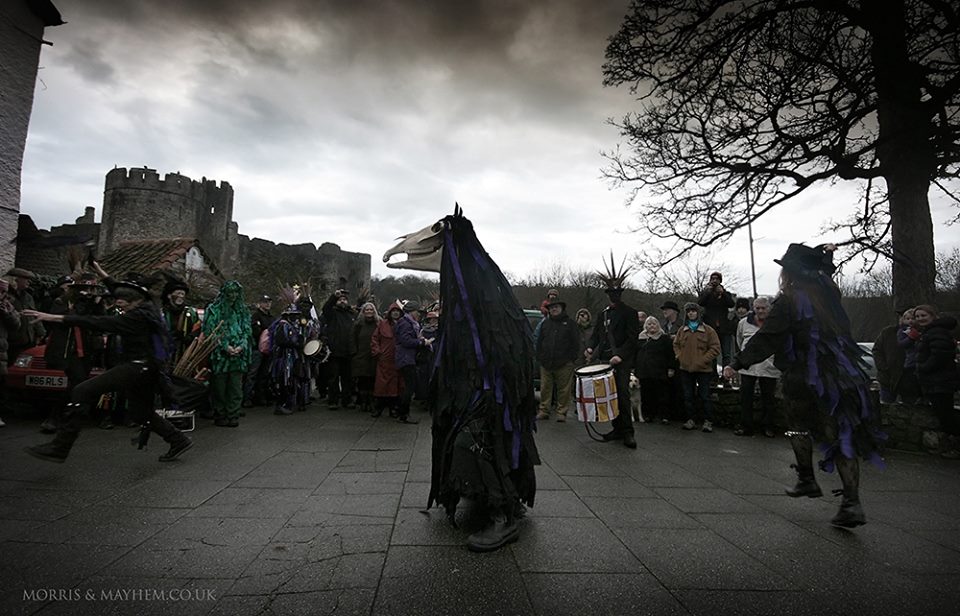
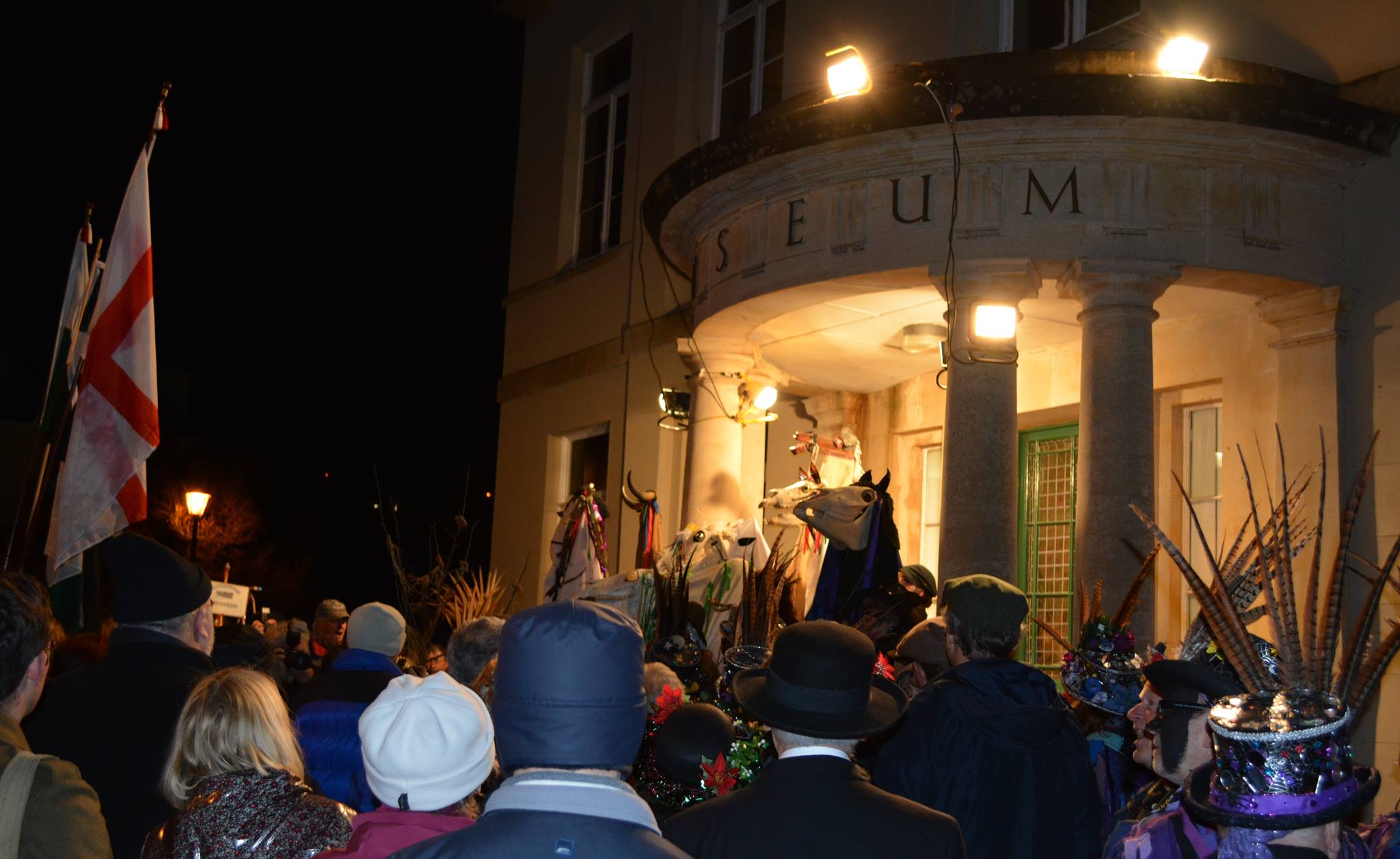
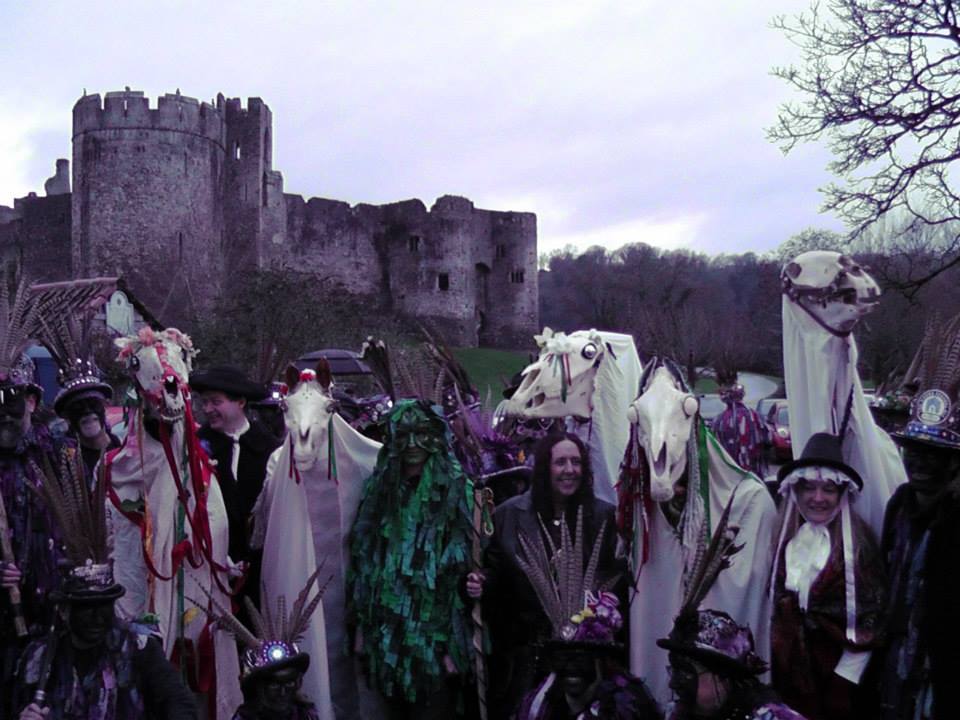
Near the warmth of our hearths we tell ghost stories, by candlelight we share tales of our ancestors, each alluding to the fact that the time of greatest hope is tainted by the anxiety that winter instils. As the engine of the New Year is ignited, we are not yet out of the woods. Dark spectres lurk in corners, disembodied whispers reach out from the shadows, and the thin veils between the worlds of the living and the dead herald the arrival of another spirit – the Mari Lwyd (The Grey Mare) As the feasting of Solstice and Christmas move into full swing, the Mari Lwyd appears in darkened streets. Her troupe, who themselves represent the dead, guide her to the enticing lights of celebration. They lead a stark white skull of a horse, adorned in ribbons, a flowing white gown about her form, with jaws that snap at those whose poetic prowess fail to gain her admiration. She comes from the land of the dead, from the Otherworld, a reminder of the function of winter and the mysteries of life, death and rebirth.

Midnight. Midnight. Midnight. Hark at the hands of the clock. What shudders free from the shroud so white stretched by the hands of the clock?
She is shrouded in mystery, her origins are unknown. Some claim that the tradition reaches back to Pagan times. Others claim an unbroken tradition of bringing out the Mari. The truth of her history may never be revealed to us, and to an extent this matters not. What does matter is that she lives, she is a living tradition, and one that is enjoying a revival in Wales and further afield. A living tradition changes with time and with the people that imbibe life into the remnants of ancient practise.
The Grey Mare probably evokes a memory of the function and sacredness of Horses. The horse was revered in Celtica as a symbol of power and fertility and long associated with the Goddesses Epona and Rhiannon. White animals in particular had the ability to cross from the Otherworld to our world, and one wonders if the stark whiteness of the Mari is indicative of this belief. Horse deities were representative of the sovereignty within the land, and even in winter she appears albeit as a dead horse, animated if only for one night to express mystery.

O white is the starlight, white on the gate and white on the bar of the door. Our breath is white in the frost, our fate falls in the dull wave’s roar. O rhyme with us now through the keyhole’s slit, and open the door if you fail. The sea-frost, brothers, has spurred our wit, ay, and the killing hail.
Whilst we may have lost the actual meaning of the Mari Lwyd tradition, to be near her is to sense the mystery that she expresses. There is an undeniable magic to her presence that seems to tease at long lost memories hid in the depths of our cultural memory. The folk traditions of Wales have embraced the Mari, for to be in her presence is to be lost in the magic of song and poetry. Battles of bardic wit take place between the Mari party and those who occupy the homes and taverns that she visits. Lose the battle and she gains entry into the warmth of company where chaos ensues. She reminds us of misrule that social norms are suspended and that within the joyousness of celebration there lurks a human desire to suppress the anxiety that winter instils.
Her jaws snap at the living, and yet laughter and music fills the air. But perhaps her snapping is indicative of a deeper mystery, where the Mari attempts to maintain her hold on the wheel of the year. Snapping at genitals could well be an attack on fertility, the threat that spring and its new life will not come and that winter and the Mari will rule forever!

Out in the night the nightmares ride; and the nightmares’ hooves draw near.
She is the Night Mare, the queen of winter, and at her altar we leave offerings of song, poetry, coins and beer in the hope that she will be appeased. But she is a hard mistress, the songs must be worthy of her admiration, the beer good and accompanied with perfect poetry. To lose is to face consumption into the jaws of the Goddess.
As the hooves draw near, and when the dreaded knock cracks on wooden doors a song must be prepared –
Wel dyma ni’n diwad (Well here we come)
Gy-feillion di-niwad (Innocent friends)
I ofyn am gennad (To ask leave)
I ofyn am gennad (To ask leave)
I ofyn am gennad i ganu (To ask leave to sing)
Mae Mari Lwyd yma, (Mari Lwyd is here)
A sêr a ribanau, (In stars and ribbons)
Yn werth I rhoi goleu, (Worthy of giving light)
Yn werth I rhoi goleu, (Worthy of giving light)
Yn werth I rhoi goley nos heno. (Worthy of giving light tonight)
Mae Mari Lwyd lawen, (Merry Mari Lwyd)
Yn dod yn y dafarn, (Is coming to your tavern)
I ofyn am arian, (To ask for money)
I ofyn am arian, (To ask for money)
I ofyn am arian a chwrw (To ask for money and beer)

Mari Lwyd, Lwyd Mari: A sacred thing through the night they carry.
A sure sign of the power within the sacred is when it easily transfers itself into the celebratory practises of secular communities. And this is happening here in Wales, ‘Trac’ the folk development organisation for Wales’, have created an information package and a flat pack Mari with full instructions on how to use her. Several Mari Troupes have arisen over the years and combine Winter Solstice, Christmas, New Year and Wassail traditions throughout Wales and the borders of England. The Mari is very much alive. Other groups perceive the sacred within this practise and that the Mari expresses more than a celebratory function, and that hid beneath her flowing white robes is the seat of mystery. To this group the Mari is an expression of the Goddess, the divine feminine principle. What both parties share is a common love of tradition and of making those traditions relevant to the 21st Century. The Goddess, the Mari cannot be silenced, she is more powerful than the wont of man to destroy her, and attempts have been made to silence her.
In the 19th Century a Baptist minister called William Roberts attempted to bring an end to what he perceived as a pagan practise. He authored a book called ‘Crefydd yr Oes Dywyll’ (Religion of the Dark Age), and in it gave a detailed account of the Mari and over 20 verses of the songs (Pwnco) associated with her. He hoped that this would enable his congregation to identify the Mari tradition and put a stop to it. It had the opposite effect. The Welsh seized the material and devoured it hungrily, the Mari was revived rather than suppressed. The poor man must be spinning in his grave!

Midnight. Midnight. Midnight. Hark at the hands of the clock. O crouch and cringe by the bounding flame and close your eyelids fast. Out of the breath of the year we came. The breath of the year has passed. The wits of a skull are far too great being out of the hands of the clock. When Mari Lwyd knocks on the door, in charity answer that knock.
She is bridled with shadows and saddled with song, and now she has come knocking at your door. Will you heed that knocking? Will you help to bring back the Mare Queen of winter, to sing her songs of Bardic wit, to oblate her with offerings, to invite mystery into the warmth of good company? One of the most powerful reasons for reviving these old traditions is because they work. They do something to the internal constitution of a community, they allow expressions of music, song and poetry, they bring people together in a manner that may be too subtle to adequately articulate. They cause us to remember something of our deep past.
We cannot prove if the Mari is a direct link to the ancient Celtic past, or that she is a remnant of an actual pre-Christian tradition. But this does not matter, what matters is the manner in which we make her relevant to today. She brings another level of magic and wonder, awe and joy to the glorious celebrations at the heart of winter.
O white is the frost on the breath-bleared panes and the starlike fire within, and our Mari is white in her starry reins starved through flesh and skin. It is a skull we carry in the ribbons of a bride. Bones of the Nightfrost parry, bones of the Fire inside.
(Paragraphs in Italics taken from the ‘Ballad of the Mari Lwyd’, Vernon Watkins 1906 – 1967.)

Follow this link for a video history of the Mari Lwyd –
Follow these links to listen to the Mari Lwyd song –





 Grumpy Old Witchcraft